
Julen Lopetegui targets World Cup statement with Qatar after rebuilding his reputation
The former Wolves and West Ham boss says leading Qatar to a first World Cup qualification on merit ranks among the standout achievements of his career, with England still firmly on his radar.
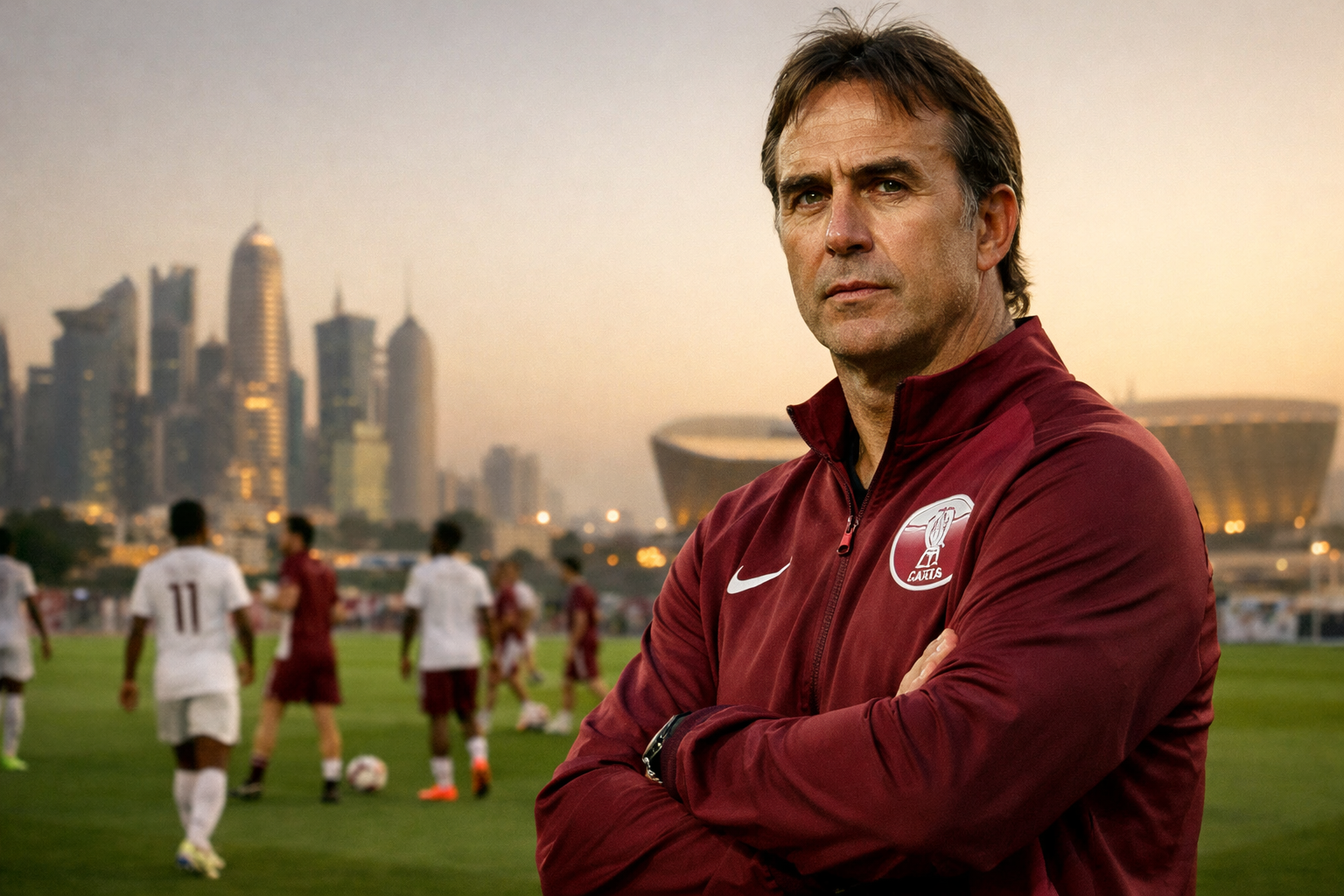
Julen Lopetegui has never lacked belief in his methods, even if his career has often prompted debate. From rescuing Wolverhampton Wanderers to an abbreviated spell at West Ham United, and from European success with Sevilla to the cruel ending of his Spain tenure before the 2018 World Cup, the Spanish coach has built a résumé that is stronger than many of his critics admit.
Now he has added another line he clearly treasures: guiding Qatar to the 2026 World Cup.
Speaking from Doha, Lopetegui described the achievement as one of the defining moments of his coaching life. Qatar had only appeared at a World Cup before because they hosted the tournament in 2022. This time, they are there on sporting merit, and Lopetegui sees that as something historic.
Why the Qatar job matters so much
Lopetegui pointed to several milestones across his career when reflecting on where the qualification sits. He mentioned winning the Europa League with Sevilla and helping the Spanish club secure repeated Champions League qualification. He also looked back at his work with Wolves, where he inherited a team at the bottom of the Premier League and led them to safety with an impressive run of results.
But Qatar’s achievement occupies a special place for him because of its significance to the nation’s soccer history.
For Lopetegui, the context matters. This was not a traditional powerhouse with a deep production line of elite talent. It was a side trying to compete despite structural limitations, and doing so under intense pressure after he took charge in 2025.
Qatar came through a difficult route, including a key result against Iran to stay alive and then a decisive playoff win over the United Arab Emirates. That victory, according to Lopetegui, changed the mood of the country.
He also noted the challenge posed by the UAE, who had reshaped their squad in recent years and drew heavily from naturalized players, including several with Brazilian roots. Qatar had suffered heavily in earlier meetings, but under Lopetegui they were better organized and more competitive when it mattered most.
Building a national team with a small player base
One of the clearest themes in Lopetegui’s reflections was the reality of Qatar’s player pool. He stressed that the country has a very limited number of passport holders, dramatically narrowing the base from which a national team can be built.
That issue is compounded by the domestic league itself. In his view, many Qatari players struggle to get consistent minutes because foreign players occupy important positions at club level. As a result, the national team staff must squeeze every possible gain from preparation, recovery, nutrition, and tactical detail.
Lopetegui did acknowledge that Qatar has excellent infrastructure and a population increasingly passionate about the game, especially after hosting the 2022 World Cup. But for any coach, he argued, facilities only go so far. Ultimately, the biggest resource is the quality and availability of players.
That is why his work with Qatar has centered on optimization. Every session, every camp, and every detail has to count if the team is to remain competitive against stronger opponents.
Adapting to Ramadan and a different rhythm
Managing Qatar has also meant adjusting to a football calendar and daily routine different from what Lopetegui experienced in Europe.
During Ramadan, training schedules are shifted deep into the evening to account for fasting hours. Lopetegui said sessions can begin as late as 8:30 p.m., requiring players and staff to operate on a very different body clock. Nutrition support becomes especially important during that period, with the federation working closely to help players maintain performance while respecting religious obligations.
It is another example of the flexibility required in the role. Lopetegui has coached in Spain, England, and at international level before, but he made clear that the Qatar job has demanded a new kind of sensitivity and planning.
Communication has also required adaptation. English is commonly used within the squad, though translation support is needed at times in Arabic. Despite those practical challenges, Lopetegui praised the players’ commitment and desire to improve, qualities he sees as essential given the level of opposition awaiting them next summer.
Qatar’s World Cup plan is already underway
Lopetegui is realistic about where Qatar stand. He knows many countries would welcome drawing them in the group stage. That honesty, though, does not come with resignation.
Instead, he says the objective is to become as competitive as possible and try to surprise people. Preparations have been designed around demanding friendlies, with tests against opponents such as Serbia, Argentina, Ireland, and Paraguay intended to sharpen the side before the tournament begins.
Qatar’s group-stage schedule presents a major challenge. They are set to open against Switzerland in San Francisco, then face Canada in Vancouver, before finishing against the winner of European playoff path A in Seattle. That final opponent could be Bosnia and Herzegovina, Italy, Northern Ireland, or Wales.
The travel, in Lopetegui’s mind, is manageable. He appears comfortable with the logistics and the climate, especially compared with the punishing conditions he remembers from the 1994 World Cup in the United States, when he was part of Spain’s squad as a goalkeeper.
He also sees practical factors like cooling and rehydration breaks as part of the modern tournament landscape. Those pauses can help players physically, but coaches also know they create useful moments for tactical adjustments.
The World Cup has unfinished meaning for Lopetegui
This tournament carries a personal edge for him as well.
Lopetegui was present at USA 94 but did not play. Then, after coaching Spain through an excellent unbeaten stretch and successful qualification for Russia 2018, he was dismissed just before the tournament after his agreement to join Real Madrid became public.
He still speaks with obvious pride about that Spain team. He highlighted the unbeaten run and results against elite opponents, including England, Italy, Belgium, and France, believing the side was well set for a strong World Cup.
That chance disappeared before the first match.
So while he frames Qatar’s qualification as a national milestone, it is also clearly a personal return. This time, he will arrive at a World Cup with the opportunity to shape events from the bench rather than watch them slip away.
Looking back at Wolves and West Ham
Lopetegui’s comments on his recent club jobs in England offered a reminder of why he remains an intriguing figure in the Premier League conversation.
At Wolves, he still speaks warmly about the supporters, the city, and the survival mission he helped complete. He believes the relationship ended not because of results, but because promised plans for strengthening the squad were not carried out after safety had been secured.
Even so, there is no bitterness in the way he talks about the club. The tone is closer to disappointment than anger, paired with genuine affection.
His view of West Ham is similar in one respect: he believes time may ultimately soften the judgment of his spell there. He pointed out that the team was in 14th place when he left, still above the relegation zone, and suggested that the January transfer window was going to be important for reshaping the defense and pushing the side forward.
Instead, the club made a change before he could act.
Lopetegui said he felt the players had bought into his methods, making the dismissal frustrating, but he did not dwell on regret. Rather, he framed it as another chapter in a career that has repeatedly required him to rebuild and respond.
A clear message to the Premier League
If there was one takeaway from his reflections on English football, it was that he wants to return.
Lopetegui remains an admirer of the Premier League’s intensity, atmosphere, and fan culture. He described it as the best competition in the world, with the passion around matches standing out above all.
That admiration has not faded since moving to Qatar. He still follows results closely and smiles at the contrast between England’s rain and Doha’s sunshine. But beneath the light-hearted comparison is a serious ambition.
He plainly sees another Premier League job as part of his future.
For now, though, that can wait. Qatar’s World Cup campaign is the immediate priority, and it offers Lopetegui something he has chased for a long time: the chance to leave a mark on the biggest stage in the sport.
After twists through club rescues, European silverware, and one of international football’s most dramatic pre-tournament exits, he now has a fresh opportunity. And if Qatar can turn their historic qualification into a credible showing in North America, the coach’s reputation may look very different by the end of 2026.