
Inside Arjan Wijngaard’s 3,000-Shirt Football Archive
The Dutch collector has spent nearly 25 years building one of Europe’s most remarkable football shirt collections, turning a room in his home into a living record of the game’s visual history.
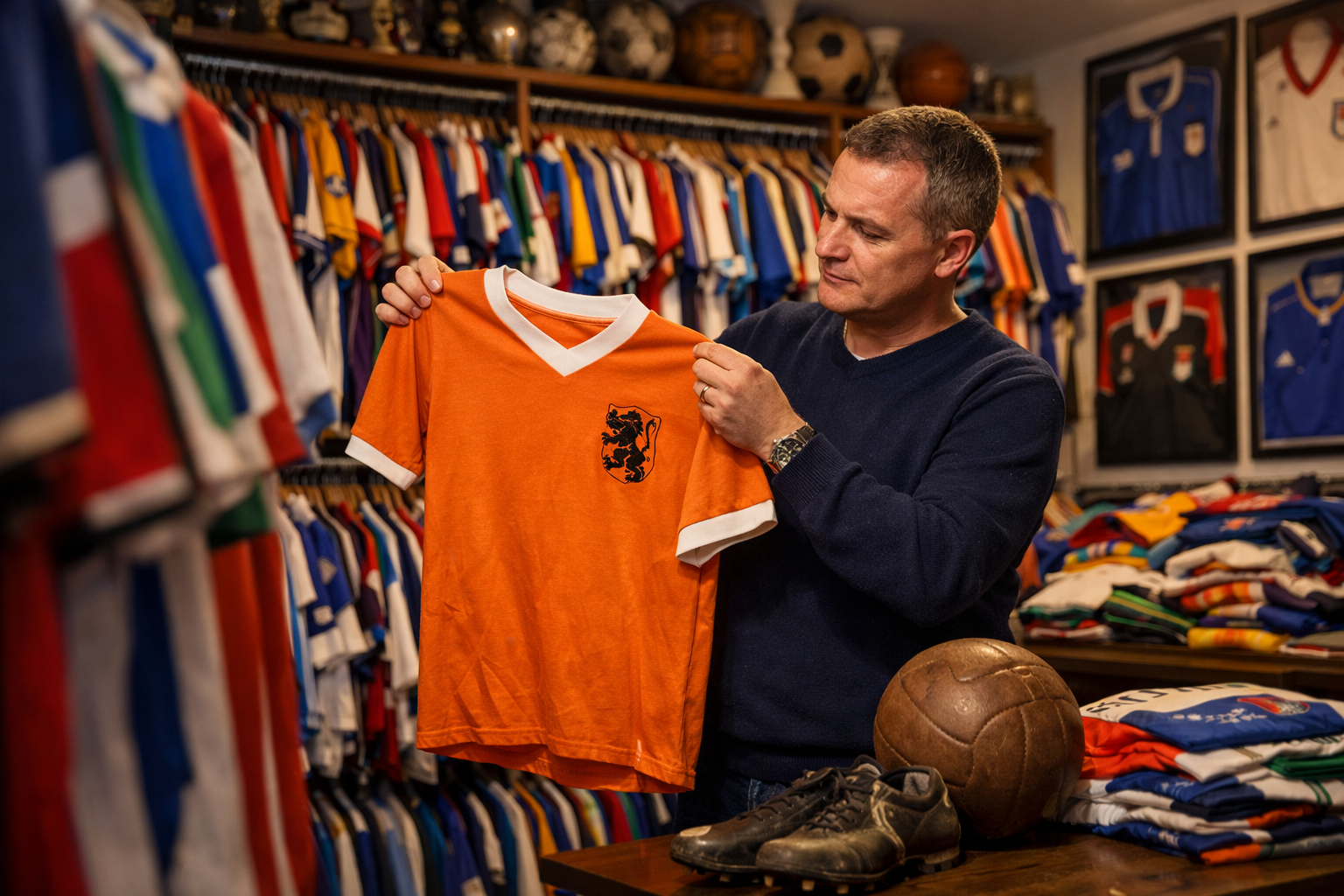
For most supporters, buying a football shirt is a memory attached to a season, a player or a single day out at the stadium. For Arjan Wijngaard, shirts became something much bigger: an archive of the game itself.
The Dutch collector has amassed close to 3,000 classic football kits over nearly 25 years, building one of the most extensive private collections in Europe. What began with an Everton shirt gifted to him in 1997 has grown into a project that now occupies its own exhibition space at home and lives online through his extensive catalogue at https://www.voetbalshirts.org.
Wijngaard’s collection is not built around hype releases or only the biggest clubs. Its appeal lies in range, rarity and football geography. Alongside recognisable names are shirts from obscure lower-league sides, hard-to-source teams and clubs from countries that sit well outside the usual centre of the European football conversation.
A collection shaped by curiosity
Wijngaard admits there was no grand masterplan at the start. He loved football first, and shirts became the object through which that love took shape.
He has joked that scarves or pins might have been the more practical option. They are cheaper, easier to store and far less demanding on space. Anyone who sees the room housing his collection will understand the point immediately. Racks cover the walls from top to bottom, packed with colour and pattern, while mannequins and memorabilia turn the room into something closer to a football museum than a spare room.
Still, the scale is only part of the story. The character of the collection comes from the choices behind it.
Wijngaard is especially drawn to clubs that are difficult to find in the usual marketplace. That means non-league and lower-league teams, including deep levels of the English pyramid, as well as clubs from countries not normally associated with the commercial shirt boom. In a collecting scene often driven by elite brands and famous eras, his approach is closer to preservation than simple accumulation.
Why the website matters as much as the shirts
A collection of this size can easily become impossible to manage without some kind of system. Wijngaard’s answer was to build a detailed online catalogue, organising shirts by country, club and division.
That decision served several purposes at once.
- It allowed other collectors and football fans to see the scale of what he had built.
- It created a record for insurance purposes in case of theft, fire or damage.
- It made it easier for him to track what he already owned when shopping online or travelling abroad.
That last point matters more than it might seem. Once a collection stretches into the thousands, memory is no longer enough. Documentation becomes essential. In that sense, Wijngaard’s project reflects a serious archivist mindset. The website is not just promotion. It is infrastructure.
His social channels under the Voetbalshirts.org name also extend that work, helping him connect with fellow collectors and with club volunteers, fans and sellers around the world. What might look from the outside like a solitary hobby is, in practice, highly networked.
The search is part of the reward
Before travel restrictions disrupted regular movement, Wijngaard would make around five trips a year to other countries in search of shirts, with Britain a frequent destination. His preference has always been to buy directly from club shops near the stadium whenever possible.
That tells you something important about the way he sees collecting. The shirt is valuable, but so is the route taken to get it. Stadium visits, local fan culture and the act of finding an item in its natural setting all add meaning.
When travel is not possible, he turns to online club shops, eBay, Facebook groups and a network of collectors built over many years. Like most specialist collecting communities, football shirt culture runs on trust, reputation and shared knowledge. The longer someone is in it, the stronger those connections become.
For Wijngaard, those relationships are one of the best parts of the entire process. He has spoken about the pleasure of meeting other collectors, talking football, helping each other source shirts and hearing from volunteers proud of their local clubs. The social fabric around the hobby matters as much as the objects themselves.
More than memorabilia
That wider community element helps explain why shirt collecting has grown so sharply in recent years. A football shirt is not only merchandise. It can function as identity, local history, design culture and personal memory all at once.
Wijngaard’s collection makes that visible in an unusually complete way. One shirt might represent a tiny non-league side. Another might preserve a design language from a now-vanished sponsor era. Another might connect to a stadium visit, a friendship or a trade completed through contacts on the other side of the world.
Taken together, the archive becomes a map of football culture beyond the biggest televised competitions. It reflects the sport’s local roots as much as its global spread.
That is also why his favourite pieces carry stories rather than simply market value. One of the shirts he treasures most is an old FC Groningen matchworn shirt that is rare, nearly 40 years old and tied to his local club. In collecting terms, rarity matters. In emotional terms, belonging matters more.
The local club at the centre
For all the global reach of the collection, Groningen remains central to Wijngaard’s football life. It is his local team, his stadium is only a short bike ride away and he has held a season ticket for almost 30 years.
He has framed that attachment in simple terms: support your local club. That principle helps make sense of his collecting philosophy. He is interested not only in glamour clubs but in football as lived culture, rooted in places and communities.
His affection for Everton also fits that pattern. The first shirt he received became the first step in a much larger journey, and he has described Everton, Groningen and Feyenoord as clubs with a strong people’s-club identity. That language says plenty about the kind of football stories he values.
This is not collecting as status display. It is collecting as connection.
The one shirt still missing
No collection is ever truly finished, especially not for someone who openly says he has no plans to stop. Even with thousands of shirts already logged, Wijngaard still has targets.
The standout one is deeply personal: a matchworn Groningen cup final shirt from 2015. Groningen’s KNVB Cup win remains the club’s only major trophy, so the shirt carries obvious significance. It is local history condensed into fabric.
That wish also says something broader about why collectors keep going. The goal is not simply to increase the number. It is to fill in stories, to add missing pieces and to chase items that carry emotional weight no general market ranking can measure.
He also remains eager to add shirts from non-league clubs he does not yet have, especially those that might otherwise never appear in mainstream collecting circles. In an era when football nostalgia often gets commercialised around a familiar shortlist of elite teams, that instinct feels valuable.
A quiet archive of football culture
Wijngaard has been active in the online shirt community since long before football shirt collecting became a mainstream trend. That gives his project a different texture from the newer resale-led market that now surrounds vintage kits.
There is seriousness in the way he documents each item, but there is also generosity in the way he shares the collection. The website opens up what would otherwise be a private archive. Fans can browse by country and club, tracing football’s visual culture through hundreds of teams they may never have seen play.
In that sense, the collection does not just preserve shirts. It preserves football’s breadth. It reminds us the game is not only made by the giants of the Champions League era, but also by local clubs, lower divisions, forgotten sponsors, regional colours and one-off seasons that still matter to the people who lived them.
Wijngaard’s room full of shirts is impressive on its own terms. But the more interesting story is what sits underneath it: decades of travel, conversation, loyalty, cataloguing and curiosity.
For a sport that moves quickly and forgets easily, that kind of patient collecting has real value.
And if he gets his way, the archive is still only getting started.