
How Bobby Robson’s Ipswich Town came agonisingly close to a 1981 treble
A small squad, a revolutionary midfield and a punishing fixture list carried Ipswich Town to the edge of league, cup and European glory under Bobby Robson in 1980-81.
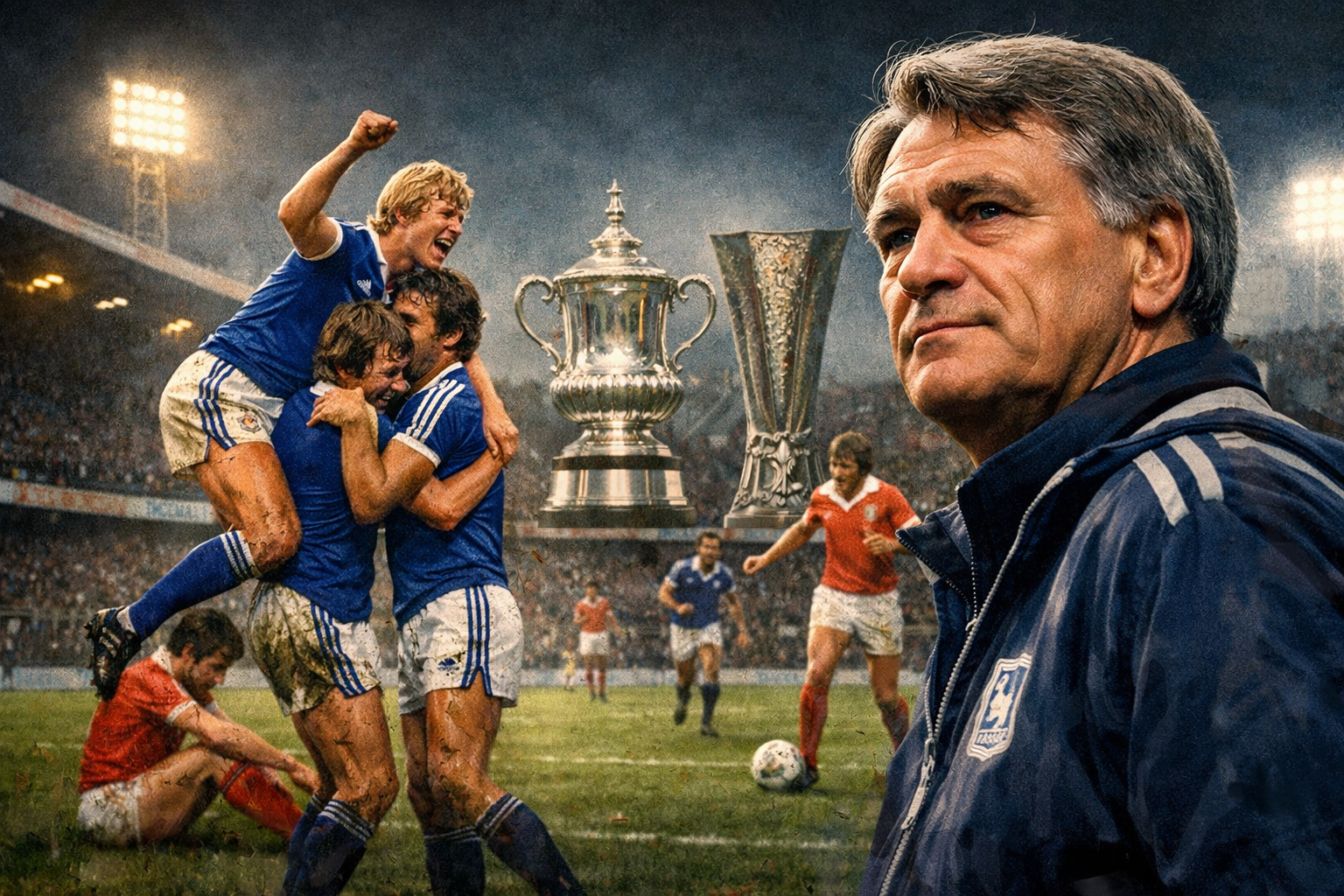
Ipswich Town were never supposed to dominate English football’s imagination. Tucked away in Suffolk, far from the financial and cultural pull of England’s biggest cities, they were a provincial club with moments of significance rather than a permanent seat at the top table.
Yet by 1980-81, under Bobby Robson, Ipswich had become one of the smartest, toughest and most watchable sides in the country. They were good enough to challenge Liverpool’s domestic authority, bold enough to trust technical continental players in an insular era, and resilient enough to stay alive in three major competitions deep into spring.
They did not complete the treble. In truth, the schedule eventually made sure of that. But the scale of what Robson’s side achieved still stands as one of English football’s great near-misses.
The foundations were already in the club’s history
Ipswich had done the improbable before. Alf Ramsey took over in 1955 with the club in the third tier and, within a handful of seasons, transformed them into champions of England. That rise gave Ipswich an identity beyond their size: a club capable of punching far above its weight when the right manager and the right group aligned.
Robson arrived in January 1969 and spent the next decade building another version of that idea. He developed a side that was organised, intelligent and consistently competitive. FA Cup glory arrived in 1978 with a 1-0 win over Arsenal, a result that actually flattered the beaten finalists given Ipswich’s control of the game.
By the end of the 1970s, Ipswich were no novelty act. They were established as a top-side irritant, strong enough to trouble anyone and good enough to finish near the summit. The next question was whether Robson could convert that into a genuine title challenge.
Robson built a squad ahead of its time
The most striking feature of that Ipswich team was not just its quality, but its balance.
At the back, Robson had a defensive core full of authority. Paul Cooper gave them reliability in goal and a specialist edge from the penalty spot. In defence, Mick Mills, Terry Butcher, Russell Osman and George Burley provided leadership, aggression and consistency. For periods, Ipswich supplied much of England’s own back line.
But the real innovation came in midfield.
English football at the time was still deeply suspicious of foreign players. The assumption was that technical imports would struggle with the pace, the physicality and the winter conditions. Robson ignored the prejudice and went to FC Twente for Arnold Muhren and Frans Thijssen.
That decision changed the team. Muhren and Thijssen gave Ipswich calm on the ball, angles in possession and a level of technical fluency that stood out in Division One. They were not signed as luxuries. They were central pieces in a side that could mix directness with control.
Alongside them was the perfect counterweight in John Wark, a midfielder who seemed to cover every blade of grass and arrive in scoring positions with uncanny timing. Wark was relentless, combative and extraordinarily productive. In 1980-81, he would become the season’s defining figure.
Further forward, Paul Mariner offered presence and finishing, Eric Gates brought craft and sharp movement, and Alan Brazil added another international-level option. This was not a huge squad, but it was an excellent one.
A fast start turned possibility into belief
Ipswich opened the 1980-81 season with the kind of run that quickly changes internal targets. They won seven of their first eight league games and established themselves as more than early overachievers.
Wark set the tone with goals from midfield, while Portman Road became a place where even strong sides suffered. Everton were beaten 4-0. The points tally built quickly. In the era of two points for a win, small gaps mattered, and Ipswich created one.
There were sterner tests to come, but Robson’s side passed those too. Draws against Liverpool at Anfield and Manchester United preserved their unbeaten start and reinforced the sense that Ipswich belonged in the title conversation.
At the same time, Europe was beginning to offer its own storyline.
The UEFA Cup run gave Ipswich continental weight
Ipswich’s UEFA Cup campaign began with a pattern that would repeat itself for much of the season: emphatic work at home, danger away.
Aris Salonika were dispatched 5-1 at Portman Road, with Wark scoring four times, before a difficult return leg nearly complicated matters. Bohemians Prague were handled similarly. Widzew Lodz, who had already eliminated Manchester United and Juventus, were then swept aside 5-0 in Suffolk, another night powered by Wark’s finishing.
Those results moved Ipswich from interesting outsiders to genuine contenders. Still, the quarter-final against Saint-Etienne looked like the point where the run might end.
It did not.
Instead, Robson’s side produced one of the great European performances by an English club of that period. Away in France, against a side carrying major pedigree and featuring Michel Platini, Ipswich recovered from going behind to win 4-1. Mariner scored, Muhren smashed in a magnificent effort from distance, and Wark added another to a campaign that increasingly seemed built around his instinct for the decisive moment.
The return leg was won 3-1. Suddenly, Ipswich were not just surviving in Europe. They were imposing themselves on it.
The treble became realistic, then the calendar turned brutal
By the start of spring, Ipswich were top of the league, alive in the FA Cup and charging toward the latter stages of the UEFA Cup. The treble was no longer romantic nonsense. It was a live possibility.
They reached the FA Cup quarter-finals and edged past Nottingham Forest after a replay. They moved into the UEFA Cup semi-finals. They stayed in front, or close enough to it, in the league race with Aston Villa.
Then came the cost.
Robson was managing a superb side, but not a deep one. The same trusted players were carrying league pressure, cup ties and European nights all at once. As the fixtures tightened, the margins narrowed.
March brought warning signs in the league with away defeats at Manchester United and Leeds. Even then, Ipswich ended the month top, but the wear was beginning to show.
April was where the season became a test of physical and mental endurance as much as football quality.
April broke the treble dream
The month was relentless. Ipswich had league matches, a UEFA Cup semi-final against Koln and an FA Cup semi-final against Manchester City, often with barely enough recovery time between them.
They lost at West Brom. They beat Koln 1-0 at home in the first leg of the European semi-final through, inevitably, a Wark goal. Then came the FA Cup semi-final at Villa Park.
It was tense, attritional and drained of fluency, which made sense for a team running on fumes. With the game in extra time, Manchester City took it through Paul Power’s famous free-kick. Ipswich could not respond. The treble was down to two trophies.
Three days later, they returned to Villa Park for what was effectively a league decider against Aston Villa. It said everything about Robson’s team that they somehow found a response. Mariner forced the opening, Brazil scored, Gates added another, and Ipswich won 2-1 to keep the title race alive.
But the strain kept building.
Arsenal inflicted Ipswich’s first home league defeat of the season. Norwich then beat them in the East Anglian derby at Carrow Road, a result that damaged the title challenge at exactly the wrong time. In between, Ipswich somehow went to Germany and beat Koln 1-0 away to reach the UEFA Cup final.
This was the contradiction of their season: a team visibly exhausted, yet still capable of elite performance because its collective level was so high.
Aston Villa took the league, but Europe remained
Ultimately, the title slipped away. Aston Villa had fewer distractions and more energy at the decisive moment. Ipswich’s defeat at Middlesbrough confirmed Villa as champions and ended the domestic part of the dream.
That left one final chance to turn a glorious season into silverware.
In the UEFA Cup final, Ipswich faced AZ Alkmaar and gave themselves breathing room in the first leg with a 3-0 win at Portman Road. Wark scored again, Thijssen struck, and Mariner added the third.
Even then, the job was not simple. Ipswich’s away record in Europe had been shaky enough to keep anxiety alive. In the Netherlands, Thijssen scored early, AZ rallied, and the second leg became a tense, chaotic shootout of momentum and nerves. Wark scored again, because of course he did, and although AZ won the night 4-2, Ipswich held on to win 5-4 on aggregate.
They were UEFA Cup winners.
Why that Ipswich side still matters
The raw numbers alone are impressive. Ipswich played 66 matches across four competitions. They finished as UEFA Cup champions, First Division runners-up and FA Cup semi-finalists. For a club with limited resources and a small squad, that was an extraordinary return.
But this team matters for more than its final positions.
Robson’s Ipswich were stylistically important in English football. They showed that technical continental players could thrive in the domestic game when placed into a coherent structure. They blended physical edge with passing quality. They attacked with purpose and played with an intelligence that felt slightly ahead of the environment around them.
Then there is Wark, whose 1980-81 campaign remains astonishing. He finished with 36 goals in all competitions, including 14 in the UEFA Cup alone. For a midfielder, in that era, in that volume of high-pressure matches, it was a remarkable output.
And there is Robson himself, whose later career at England, PSV, Barcelona and Newcastle only reinforced what Ipswich had already shown: he could build excellent teams, improve players and create football that people remembered.
The season that defined an era
Ipswich did not win the treble, but that should not be the first line of their story. The more useful truth is that they came close enough to make the attempt feel real, and they did it while carrying a workload that would overwhelm most squads even now.
They beat elite European opposition, pushed Aston Villa all the way in the title race and reached the final weeks still chasing three major honours. By the time the season ended, fatigue had taken two trophies away from them. It could not take the UEFA Cup, and it could not diminish the quality of the team.
For Ipswich supporters, 1980-81 remains one of those seasons that explains why football memories endure. There were statement wins, improbable recoveries, tactical daring and a sense that a club from outside the established power centres could still bend the game toward its own imagination.
Robson later described the 1981 side as the best team he managed. Looking back at the evidence, it is not hard to see why.