
Vincent Kompany sets Bayern Munich’s tone before PSG decider: ‘The mission is to win’
Bayern Munich head into their Champions League semi-final second leg trailing Paris Saint-Germain by one goal, but Vincent Kompany’s message is clear: forget the noise, focus on the result.
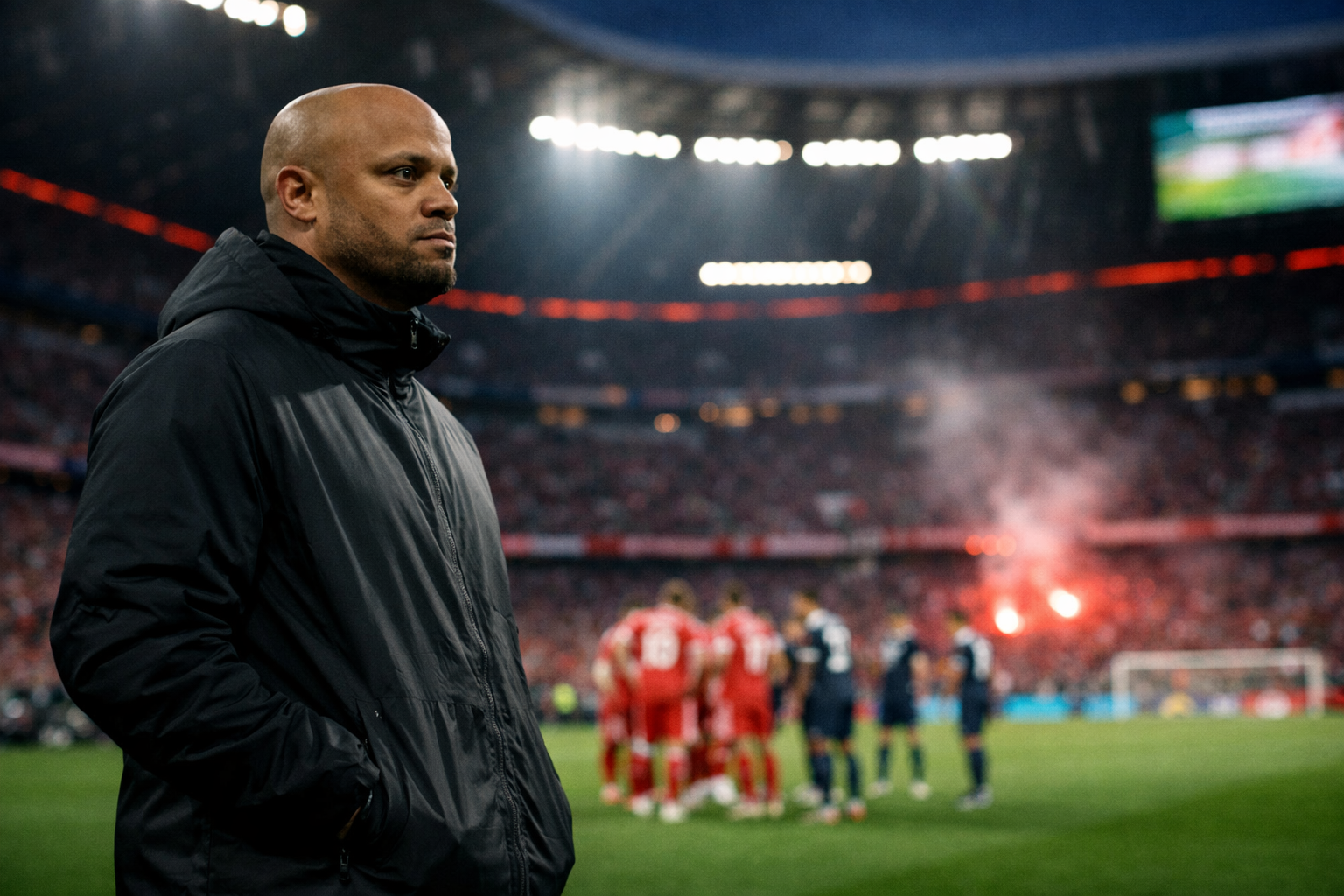
Vincent Kompany has stripped Bayern Munich’s task down to its simplest form ahead of their Champions League semi-final second leg against Paris Saint-Germain.
After a first leg that lurched from one momentum swing to another before ending 5-4 to PSG, the Bayern head coach is not interested in debates around style, perception or outside commentary. His message, delivered before the return match at the Allianz Arena, was blunt and direct: Bayern have to win.
“The mission is to win the match, that’s all that matters,” Kompany said. “We want to win this match.”
It is the kind of line that fits the occasion. Bayern are one game from elimination and one game from another European final. There is very little room now for theory.
A tie built for chaos
The first leg in Paris produced one of the wildest Champions League semi-final contests in recent memory. Nine goals, repeated momentum shifts and a single-goal margin left the tie open, but only just.
Ousmane Dembele’s decisive contribution gave PSG a 5-4 advantage, meaning Bayern enter the second leg needing to make up the deficit on home soil. The arithmetic is clear:
- a Bayern win by two or more goals sends them directly to the final
- a Bayern win by one goal forces extra time
- any other result sends PSG through
That simplicity on paper does not make the challenge any lighter. Bayern must attack without losing control, while PSG arrive carrying the kind of transition threat that can punish even the smallest structural mistake.
That tension is what made the first leg so compelling, and it is what gives the second leg its shape. Bayern do not just need pressure. They need intelligent pressure.
Kompany’s stance: substance over the conversation
Kompany’s comments suggest a manager trying to protect his team from the noise that naturally builds around a tie like this.
There have already been questions around Bayern’s playing approach, especially after a game in which they scored four times and still ended up on the wrong side of the result. But from Kompany’s perspective, this is not the moment to get dragged into philosophical discussion.
“I don’t know if we should react to what people are saying about our playing philosophy,” he said.
That is revealing. In knockout football, especially at semi-final level, style points rarely survive contact with scoreboard pressure. Kompany appears to be reframing the challenge in practical terms: Bayern do not need to win an argument; they need to win the match.
For a club of Bayern’s scale, that mentality is familiar. European nights at the Allianz Arena are usually framed by certainty and expectation, not caution. Even so, this one comes with risk. PSG have already shown they can hurt Bayern in open sequences, and Bayern know that overcommitting too early could tilt the tie away from them.
The historical backdrop offers hope — and a warning
Bayern can draw on the club’s deep Champions League history, but the numbers cut both ways.
Since the Champions League era began in 1992-93, Bayern have overturned a first-leg deficit four times in 16 attempts. That is evidence that recoveries are possible, but there is a catch: none of those comebacks came in a semi-final.
In fact, Bayern have been eliminated in all five previous Champions League or European Cup semi-final ties in which they lost the first leg.
That record gives the night an edge beyond the immediate scoreline. This is not simply about surviving one difficult game. It is about pushing past a barrier that has repeatedly stopped them at the final-four stage when chasing a deficit.
At the same time, Bayern’s place in the competition’s history remains enormous. Only Real Madrid, with 18 final appearances, have reached more European Cup or Champions League finals than Bayern. The German giants are attempting to make their 12th final, which would move them clear of AC Milan.
That is the contradiction at the heart of the fixture. Bayern are both one of Europe’s great institutions and a side trying to reverse a very specific and uncomfortable trend.
What Bayern must get right
The first leg proved Bayern can create chances against PSG. Scoring four goals in a semi-final away from home should normally leave a team in a position of strength. Instead, Bayern were exposed too often when the game became stretched.
That makes the second leg less about whether they can threaten PSG and more about whether they can control the moments between their own attacks.
A comeback of this kind usually depends on three things:
1. Managing the emotional tempo
The Allianz Arena will demand urgency, but Bayern cannot afford panic. An early goal would transform the atmosphere, yet forcing the match too quickly could open spaces for PSG to exploit.
2. Better rest defence
When Bayern commit numbers forward, their positioning behind the ball has to be cleaner than it was in Paris. Against elite transitional forwards, loose structure is an invitation.
3. Finishing the pressure phases
Semi-finals often swing on short windows rather than full-match dominance. Bayern may only get two or three sustained periods of territorial control. They have to turn those spells into goals.
Kompany may not want to engage in public tactical debate, but his team selection and in-game management will inevitably be judged through that lens once the match begins.
PSG know the tie is not done
Despite carrying the aggregate lead, PSG are unlikely to feel comfortable. A one-goal advantage away at Bayern is precarious, especially with 90 minutes — and possibly more — still to play.
The first leg gave PSG a lead, not closure.
That should make for an intriguing dynamic. Bayern must initiate the contest, but PSG have every reason to believe they can score again. That means Kompany’s side are unlikely to be facing a passive opponent simply trying to survive. Instead, they are up against a team that may look to turn every Bayern surge into an opportunity of its own.
For neutrals, it points toward another fast, unstable, high-level European occasion. For Bayern, it means the comeback cannot be built on emotion alone.
A defining night for Kompany
Whatever the broader view of Bayern’s season, nights like this shape how coaches are remembered.
If Bayern turn the tie around, Kompany will earn immediate credit for steering the club through one of the most volatile tests of the campaign. If they fall short, the conversation around approach, game management and balance will only intensify.
That is why his pre-match framing matters. By insisting that the mission is simply to win, he is trying to reduce the occasion to an executable task rather than a narrative burden.
In one sense, that is obvious. In another, it is the only useful message a manager can send before a game of this size.
Bayern know the stakes. They know the history. They know the margin for error is tiny.
Now they have to show that clarity under pressure is enough to turn a thrilling semi-final back in their favour.
At this stage, nothing else really matters.