
Thierry Henry Street Proposal in New York Reopens Ireland’s 2009 World Cup Wound
A plan to temporarily rename New York intersections after football icons ahead of the 2026 World Cup has put Thierry Henry back at the centre of one of the game’s most painful qualifying controversies.
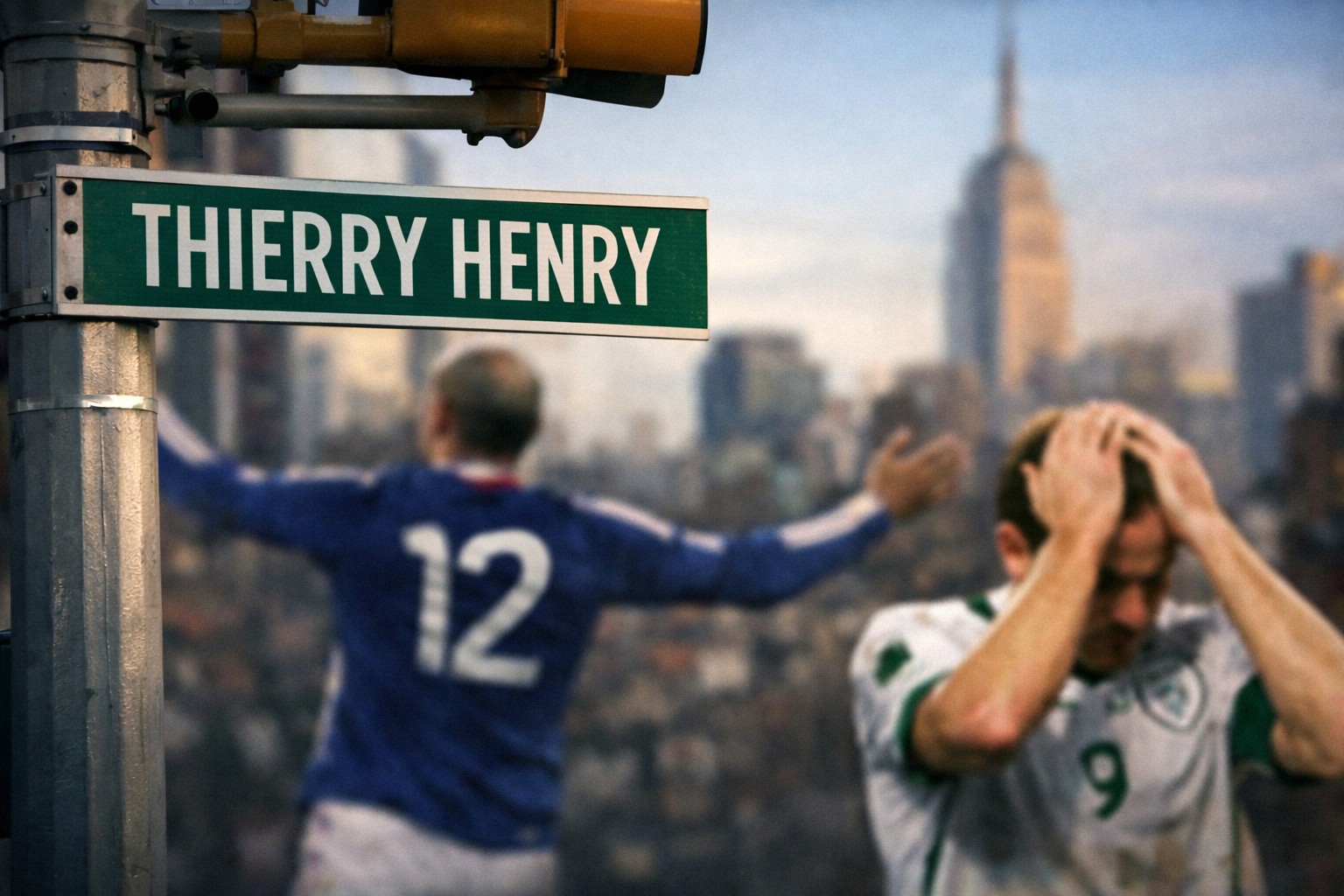
With the 2026 World Cup drawing closer, New York City is looking for ways to mark the tournament’s arrival. One civic proposal, however, has done more than celebrate football history. It has reopened one of the sport’s most enduring grievances.
According to reports from Radio-Canada, local officials are considering the temporary renaming of several city intersections in honour of major football figures ahead of next summer’s World Cup in North America. Among the names under discussion is Thierry Henry, with one Manhattan intersection reportedly being considered for a tribute.
On paper, the idea is easy to understand. Henry is one of the most recognisable footballers of his generation, and he also has a genuine connection to New York through his spell with the New York Red Bulls and his life in the city after retirement. But for many Irish supporters, his name still carries a very different association.
Why Thierry Henry still divides opinion
For Ireland, November 2009 remains a raw memory. In the World Cup qualifying play-off against France, Henry handled the ball before setting up William Gallas for the extra-time goal that sent France to the 2010 World Cup.
The incident quickly became one of the defining controversies of modern international football. Ireland were denied a place at the tournament in South Africa, while Henry’s role in the decisive moment became impossible to separate from the result.
He later expressed regret over the episode, but the apology never erased the feeling of injustice. Nearly 17 years on, that sense of hurt clearly has not disappeared.
New York’s World Cup tribute plan
The reported proposal is part of a broader effort to build symbolic momentum before the 2026 World Cup, which will run from June 11 to July 19 across the United States, Canada and Mexico.
New York, one of the key host cities connected to the tournament build-up, is expected to stage a range of football-themed events and civic gestures. The temporary renaming of intersections after iconic players is intended as a public-facing way to connect the city to the global scale of the competition.
Other legends are also said to be under consideration. Pelé, for example, has been mentioned as a possible name for an intersection in Queens. Henry’s proposed location would reportedly be at 50th Street and 6th Avenue in Manhattan.
Virginia Maloney, one of the elected officials linked to the initiative, has reportedly pointed to Henry’s ties to New York as a central reason for the nomination. From that perspective, the move is less about revisiting old football arguments and more about recognising a star who helped raise the profile of the sport in the city.
Irish reaction shows how long football memory lasts
That context has not stopped the backlash.
Sections of the American-Irish community have reacted strongly to the suggestion, with old anger surfacing almost immediately. The response has underlined a familiar truth in football culture: some moments do not fade, no matter how much time passes.
Among the reactions reported in recent days were blunt reminders of how deeply the 2009 play-off still resonates.
“He broke my heart. This is a bad idea.”
“I don’t want to speak for all of Ireland, but at the time I felt rage.”
“It’s a low blow, a blow below the belt.”
Those comments are not just about one player receiving a civic honour. They reflect the fact that, for many Ireland fans, Henry is still inseparable from a national sporting trauma.
More than a New York story
What makes this episode interesting is that it sits at the intersection of football memory, diaspora identity and World Cup marketing.
To many in New York politics, honouring famous football names ahead of 2026 is a straightforward way to celebrate the tournament. But football does not work like a neutral museum display. The sport carries emotional baggage, and the legends chosen for public recognition often mean very different things to different communities.
Henry is a perfect example. In France, he is one of the greats of the modern era. In Premier League history, he is an icon. In New York, he is a former Red Bulls star with real local relevance. In Ireland, though, his legacy is permanently shadowed by one touch of the ball.
That makes this more than a routine civic proposal. It becomes a test of how cities tell football stories in multicultural spaces where the same name can represent brilliance, pain and controversy all at once.
The 2009 play-off still lives in football culture
The original incident remains one of the most replayed and debated moments in recent World Cup qualification history.
France entered the play-off as favourites, but Ireland pushed them hard over two legs. In the decisive second leg in Paris, the tie turned on Henry’s handball before Gallas scored. Because video review was not available in the way it is now, the goal stood, France advanced and Ireland were left with outrage instead of recourse.
The fallout lasted for years.
- Ireland’s elimination became part of the country’s sporting identity.
- Henry’s public image in some circles changed permanently.
- The episode fed wider debates about officiating and the need for stronger review systems.
- It remains one of the first reference points whenever major football injustices are discussed.
In that sense, the New York reaction is not surprising. The handball is not some obscure historical footnote. It is one of those moments that still lives vividly in highlight reels, arguments and fan memory.
Will the proposal go through?
For now, the plan remains just that: a proposal. Reports suggest other football names could still be added before the issue reaches a city council vote, and it is not yet clear whether a temporary “Thierry Henry Way” will actually be approved for the summer of 2026.
That uncertainty matters, because the criticism may yet influence how the final list is shaped. Even if Henry’s name remains in place, the controversy has already changed the tone of the initiative. What may have started as a celebratory nod to football heritage has become a reminder that the sport’s past is never fully settled.
A familiar lesson before the 2026 World Cup
As host cities prepare to embrace the world’s biggest football event, this story offers a useful warning. Every attempt to package football history for public celebration also risks reviving the wounds attached to it.
The 2026 World Cup is expected to bring spectacle, nostalgia and a huge effort to connect local communities with the game’s global icons. But if New York does move forward with a tribute to Henry, it will also show that football remembrance is never simple.
For some, he is a legend worthy of recognition. For others, he remains the face of a night they have never forgiven.
That tension is precisely why the reaction has been so strong, and why a street-sign proposal in Manhattan has suddenly become an international football talking point.