
Barcelona Stall on Bastoni as Griezmann Nears Atlético Exit and Chelsea Turn to Xabi Alonso
Barcelona’s pursuit of Alessandro Bastoni has slowed at a delicate moment, Antoine Griezmann appears set to close the book on Atlético Madrid, and Chelsea have confirmed Xabi Alonso as their new head coach.
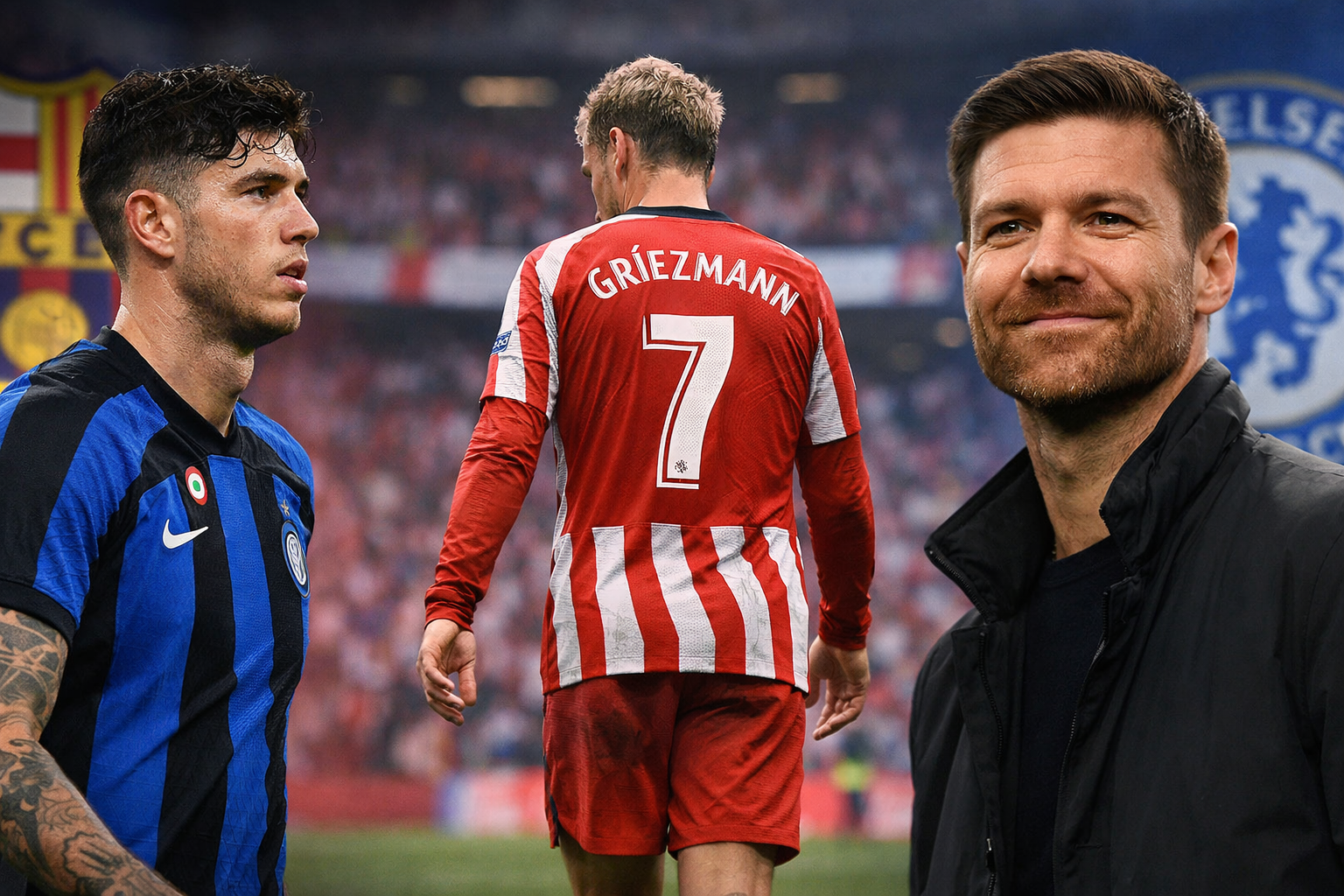
Europe’s football news cycle is moving on several fronts, with transfer strategy, emotional farewells and a major managerial appointment all shaping the conversation.
Barcelona’s long-running interest in Alessandro Bastoni has entered a tense phase, not because the move is off, but because it is slowing at a moment when neither Inter nor the player wants uncertainty. Elsewhere, Antoine Griezmann’s time at Atlético Madrid appears to be reaching its natural end, closing one of the most influential player-club relationships of the modern Simeone era. In London, Chelsea have made their next big call by confirming Xabi Alonso as the coach tasked with restoring direction and identity.
Barcelona’s delay over Bastoni raises the stakes
Barcelona remain interested in Inter defender Alessandro Bastoni, and the broad outline of the move appears to be in place on the player side. The Catalan club reportedly already has a five-year agreement lined up with the Italy international, a sign that the recruitment team sees him as a major piece in the next phase of the squad build.
The issue is that the deal has not advanced with Inter at the speed the situation now demands.
At present, Barcelona’s priority is said to be finalising the arrival of an attacker, with João Pedro positioned ahead of Bastoni in the club’s immediate planning. That sequencing matters. It means a transfer that may look conceptually straightforward is instead becoming vulnerable to delay, and delay in the market rarely comes without consequences.
Inter want clarity. Bastoni wants clarity too. Neither side benefits from a drawn-out process without a written offer on the table, especially when the player’s future is becoming a talking point beyond Italy.
Barcelona are expected to try to negotiate around the €60 million mark, but they are also considering a player-plus-cash formula to bring the total fee down. That kind of structure could make sense financially for a club still trying to balance squad needs against budget limits, but it also adds complexity. The more moving parts in a deal, the harder it becomes to close quickly.
There is also the wider risk every major club knows well: if a transfer drags, rivals get time to react.
For Barcelona, Bastoni would represent more than a marquee defensive signing. He is a left-footed centre-back with elite-level composure in buildup, defensive authority in wide spaces and the profile to anchor the back line for years. Players of that type are scarce, and when they become available even indirectly, the market tends to move fast.
That is why this is becoming a pressure point rather than a routine negotiation. Barcelona may still feel in control because of the player agreement, but Inter’s desire for a formal offer and the passage of time are changing the mood around the operation.
If the club truly sees Bastoni as a priority defender, the next step has to come soon. Otherwise, a transfer that once looked well-positioned could start to slip.
Griezmann’s Atlético chapter looks set to close
Few departures carry the weight of a genuine era ending, but Antoine Griezmann leaving Atlético Madrid falls into that category.
After 10 seasons, 212 goals and three trophies, the French forward is preparing to bring his Atlético journey to a close. The raw numbers alone place him among the club’s modern giants, but they only tell part of the story. Griezmann has not simply been productive. He has been central to the emotional and competitive identity of Atlético across one of the most significant stretches in the club’s history.
His spell in Madrid has naturally reopened an old debate: where does he rank among Atlético’s all-time greats?
For many around the club, that discussion is already settled in one direction. Former figures such as Kiko and Miguel Ángel Ruiz, along with a large section of supporters, see Griezmann as one of the defining players in Atlético history. The case is easy to understand. He delivered goals, creativity and personality, but also repeatedly showed up in the high-stakes moments that shape legacy at a club built on edge, resilience and emotional intensity.
There will always be debate over whether he is the single greatest player the club has ever had. That question is subjective, and in a club with a deep sense of history, subjectivity matters. Different generations attach greatness to different things: trophies, loyalty, aesthetics, leadership or the ability to transform a team’s level.
What feels less debatable is Griezmann’s status as a foundational figure in Atlético’s recent rise.
He became one of the faces of the club’s renaissance under Diego Simeone, a player capable of turning tight games with one action and of carrying the crowd with him. Even in seasons when silverware did not fully match the quality of the side, Griezmann remained a reference point. His influence went beyond goals. He gave Atlético imagination in attack without sacrificing the work rate and competitive edge the club demands.
That balance is a big reason he remains so revered.
Legacies at Atlético are not built on talent alone. They are built on whether a player feels like Atlético. Griezmann, for all the twists of his career, earned that status over time through output, commitment and repeated decisive contributions.
If this is indeed the end, Atlético are not just losing a forward. They are saying goodbye to one of the players who helped define what the club became in the last decade.
Chelsea hand Alonso the rebuild
Chelsea have made one of the biggest appointments of the coming season by officially naming Xabi Alonso as their new head coach.
After days of talks, the club confirmed that Alonso will begin work on July 1 and has signed a four-year contract. It is a statement decision, and one loaded with expectation.
Chelsea’s logic is clear enough. After multiple uneven seasons, constant noise around recruitment and a wider sense that the sporting project has lacked a recognisable shape, the club wants a coach who can impose a coherent football identity rather than merely survive the weekly turbulence.
Alonso arrives with exactly that reputation.
His appeal is not just tied to name recognition from his playing career, even if that naturally adds weight. What matters more is the modern coaching profile he has built, along with the authority gained from his work between Leverkusen and Madrid. Chelsea are betting that he can connect ideas, structure and player development in a way the club has struggled to sustain in recent years.
That challenge will be significant from day one.
The Chelsea job has become one of the hardest in elite football, not because the resources are lacking, but because the scale of the expectations has consistently outpaced the club’s stability. Managers have come in with strong credentials and still found it difficult to create continuity. Squad building has often looked reactive, and performances have not always reflected the cost or depth of the talent available.
Alonso’s task is therefore broader than winning early matches, although results will inevitably shape the mood. He must give Chelsea a recognisable game model, establish clear roles in a crowded squad and turn a collection of expensive pieces into a team with hierarchy and purpose.
That is why this appointment matters beyond the headline value.
Chelsea are trying to restore the link between recruitment, coaching and long-term planning. Alonso is being asked to succeed where others have struggled over the last three years: make Chelsea feel like a serious football project again, not just a club constantly reacting to its own instability.
If he can do that, the rewards are obvious. Chelsea have the talent base and financial power to climb quickly. If he cannot, the scrutiny will be immediate and intense.
Three stories, one common theme
What connects these three developments is the importance of timing in modern football.
Barcelona’s Bastoni pursuit shows how quickly hesitation can create danger in the transfer market. Atlético’s Griezmann farewell underlines how difficult it is to close a defining chapter, even when the legacy is secure. Chelsea’s move for Alonso is a reminder that clubs trying to rebuild cannot afford another lost season without direction.
All three stories are about decisions under pressure.
Barcelona now need to decide whether Bastoni is important enough to accelerate for. Atlético are confronting the emotional cost of moving on from a player who helped define an era. Chelsea have placed a major strategic bet on a coach they believe can restore order.
The details differ, but the stakes are similar. In every case, the next move matters more than the noise around it.
Over the coming days and weeks, that will be the key question: who turns a promising situation into a clear outcome, and who lets uncertainty shape the story instead.