
The Night Chile Tried to Shock Brazil: The 1989 Maracana Scandal Revisited
A World Cup qualifier in Rio became one of soccer’s strangest controversies, featuring crowd disorder, a hidden blade and a plot that unraveled through a photographer’s film.
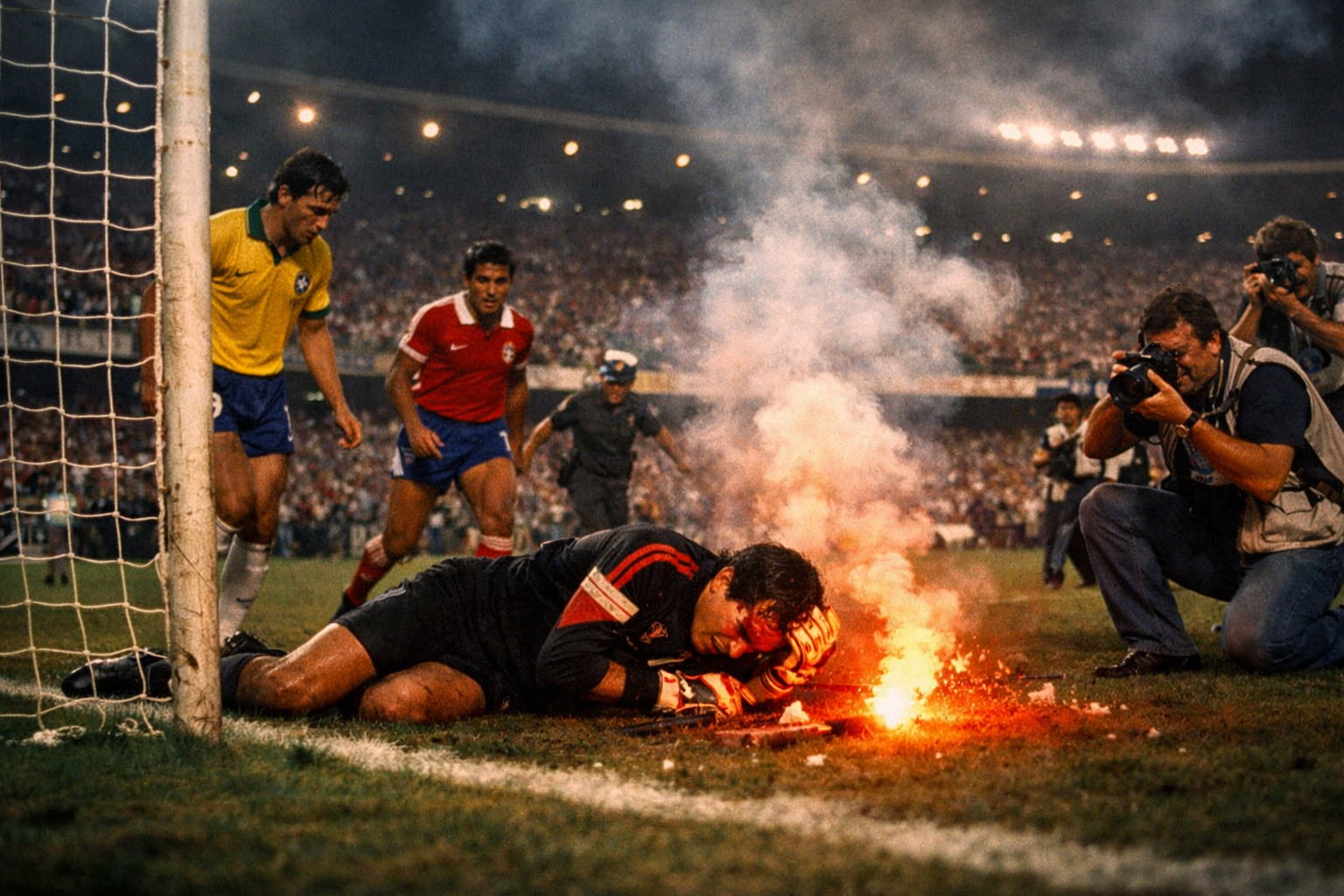
Few stories in international soccer capture the sport’s capacity for chaos quite like Brazil versus Chile in 1989. What should have been the decisive match of a World Cup qualifying group turned into a scandal involving a thrown flare, a goalkeeper carried dramatically from the pitch, and a deception so elaborate it still sounds fictional decades later.
The match is remembered not simply because of controversy, but because of the scale of the plan behind it. Chile, facing elimination, arrived at the Maracana needing a victory to reach the 1990 World Cup. Brazil needed only to avoid defeat. By the end of the afternoon, the game had been abandoned, Chile insisted its goalkeeper had been struck by a flare from the crowd, and the football world was left trying to understand whether it had witnessed a tragedy, a disgrace, or both.
Brazil’s place under threat
Brazil’s World Cup history gives little room for qualification scares. The Selecao have built their identity on always being there, always reaching the finals no matter how difficult South American qualifying might become. Yet in the closing years of the 1980s, there was real pressure around the national team.
The dazzling Brazil side of 1982 had become immortal despite failing to win the tournament. Zico, Socrates, Falcao and Eder symbolized beauty and freedom with the ball, but their loss to Italy forced a rethink. By 1986, Brazil had moved toward a more balanced approach, though they still carried plenty of attacking quality. Even so, another elimination, this time against France, deepened the sense that the nation was searching for a new formula.
That context mattered when qualification for Italia 90 began. Brazil were placed in a three-team CONMEBOL group with Chile and Venezuela. Venezuela were expected to be the outsiders, leaving the heavyweight clash between Brazil and Chile to decide who would advance.
Both sides opened by beating Venezuela. Brazil won 4-0 in Caracas with Bebeto and Romario already showing signs of a dangerous partnership. Chile also collected the points, and the first direct meeting in Santiago quickly took on major importance.
A volatile first meeting in Santiago
That August match was tense from the start. Kickoff was delayed, tempers were already frayed, and within minutes the contest had turned ugly. Romario was sent off early after an altercation with Alejandro Hisis, reducing Brazil to 10 men almost immediately. Chile soon lost Raul Ormeno as well after he picked up a second yellow card.
Even with the match stripped of rhythm by confrontation and emotion, it carried huge consequences. Brazil went ahead through an own goal and seemed set for a precious away win before Chile found an equalizer in strange fashion. Goalkeeper Taffarel was penalized for holding the ball too long, leading to an indirect free-kick inside the area. Ivo Basay converted from close range, and the game ended 1-1.
That draw left the group delicately poised. Brazil and Chile each handled Venezuela comfortably afterward, but Brazil’s superior goal difference meant the equation was clear before the return fixture in Rio: Chile had to win at the Maracana.
The decisive day in Rio
More than 140,000 fans packed into the Maracana on 3 September 1989 for one of the most charged qualifiers in South American history. Brazil were without the suspended Romario, but the attacking threat remained obvious with Careca and Bebeto leading the line. Chile, meanwhile, were missing Ivan Zamorano, a major blow for a team that needed to chase the game at some point.
The opening stages were physical, as expected. Chile defended aggressively and played with the urgency of a side that knew only victory would do. Brazil, meanwhile, controlled possession and pushed the visitors deeper. Roberto Rojas, Chile’s goalkeeper and captain, kept the score level through the first half with a series of composed stops.
Still, the pressure was building. Brazil had more of the ball, more territory and more moments around the box. Early in the second half, the breakthrough finally came. Bebeto turned cleverly and fed Careca, who finished despite Rojas getting a hand to the shot. Brazil led 1-0, and Chile’s World Cup hopes were slipping away.
For a few minutes after the goal, Chile tried to respond. But there was little sign they could find the two goals they now needed. Brazil regained control, and the match appeared to be drifting toward its logical conclusion.
Then everything changed.
The flare, the fall and the abandonment
In the 68th minute, a flare landed on the field near Rojas. Almost instantly, the Chilean goalkeeper dropped to the ground. Smoke rose nearby. Teammates rushed over. Television cameras caught Rojas writhing in apparent pain, and soon blood could be seen running from his head.
The reaction was immediate and dramatic. Chilean players surrounded the goalkeeper, tempers escalated, and forward Patricio Yanez made obscene gestures toward the crowd. With no quick restart possible and emotions running high, the Chileans carried Rojas off the field themselves and headed for the tunnel.
Brazil’s players remained on the pitch, stunned. The referee waited, hoping Chile would return. They did not. Eventually the match was abandoned.
At first glance, Brazil seemed in serious trouble. A supporter had thrown an object onto the field in a decisive World Cup qualifier. Conventional wisdom suggested a replay at a neutral venue was likely. For Chile, that would have offered an unexpected second chance.
But the story did not hold up for long.
The photographs that changed everything
One key detail bothered photographer Paulo Teixeira, who had been working near the incident. From his vantage point, the flare did not appear to strike Rojas at all. It landed nearby, but not close enough to cause the injury everyone had just seen.
Another photographer, Ricardo Alfieri, had captured the sequence on film. In an era before instant digital replay from every angle, those images became crucial. Teixeira moved quickly, helping ensure the film was processed before it could disappear into routine deadlines and confusion.
When the pictures were developed, they showed the flare landing about a meter away from Rojas. It had not struck him. Yet the goalkeeper had clearly left the field bleeding.
That created the central question of the scandal: if the flare missed him, where had the wound come from?
The hidden blade
Medical examinations soon added more doubt. Reports indicated there were no burn marks, only a cut on the side of Rojas’ forehead. FIFA looked at the evidence, including Chile’s refusal to continue the match, and eventually awarded Brazil a 2-0 victory. That was enough to send the Selecao to the 1990 World Cup.
But the full truth was even more damaging for Chile.
As the investigation deepened, it emerged that Rojas had concealed a razor blade in his glove before the game. The idea was simple and shocking: if crowd trouble or a suitable incident occurred, he could cut himself, simulate a serious injury and create the conditions for abandonment.
This was not a spontaneous decision made in the heat of the moment. Reports established that the scheme had been discussed in Chile’s camp beforehand. Head coach Orlando Aravena and team doctor Daniel Rodriguez were implicated, turning what looked like panic into a premeditated attempt to manipulate a World Cup qualifier.
Rojas eventually admitted the deception. The image of a goalkeeper bleeding beside a flare had nearly fooled the sport. Without the photographers’ evidence, it might have done exactly that.
Fallout for Chile and Rojas
The punishments were severe. Rojas received a lifetime ban from football, though FIFA later lifted it in 2001. Chile were barred from entering qualification for the 1994 World Cup, a major institutional punishment that reflected the seriousness of the offense and the abandonment of the match.
Other Chilean figures were sanctioned as well, including members of the coaching and federation setup. The scandal left deep scars on Chilean football, not only because of the penalties but because of the damage to the national team’s reputation.
There was also fallout on the Brazilian side. The supporter who threw the flare, Rosenery Mello, was identified and fined. She became a strange celebrity in Brazil afterward, a reminder of how football scandals can produce bizarre side stories alongside the main drama.
Yet the central fact never changed: Brazil had been wronged by the act of a fan, but Chile had tried to turn that misconduct into a route to the World Cup.
Why the scandal still matters
Soccer has seen many examples of exaggeration, gamesmanship and outright deception. Players have feigned contact, teams have sought advantages through delay and confusion, and objects thrown from the crowd have created ugly scenes in stadiums around the world. But the 1989 Maracana case stands apart because it involved preparation.
This was not just simulation. It was a plan built in advance, complete with a hidden blade and an expectation that disorder in the stands could be weaponized.
That is why the match still occupies such a strange place in football history. It sits at the intersection of crowd violence, sporting pressure, and calculated fraud. It also belongs to a different media age. In the modern game, dozens of broadcast angles, social media clips and fan videos would likely expose the truth within minutes. In 1989, the outcome depended on sharp eyes, old-school film and the persistence of journalists who refused to accept the first version of events.
Brazil went on to the World Cup. Chile went into disgrace. And one of the most notorious episodes in South American football became a permanent warning about how far desperation can push a team when everything is on the line.