
Simone Inzaghi Says Inter Exit Came After Final Humiliation
The former Inter manager has explained why he walked away after the club’s brutal Champions League final loss, insisting the decision only crystallized once the season’s collapse was complete.
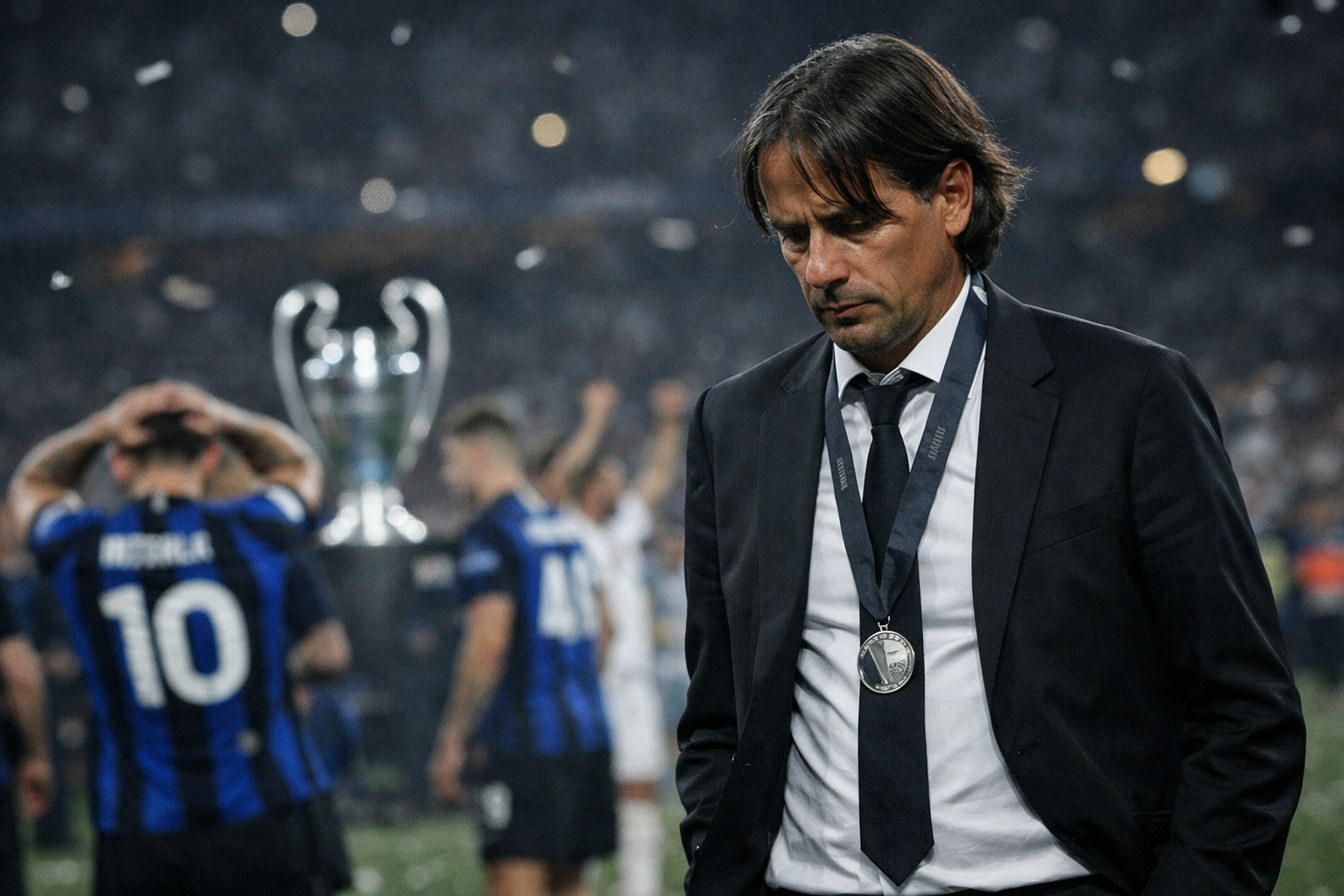
Inter’s disastrous finish to the 2024-25 campaign is still casting a long shadow, and Simone Inzaghi’s latest comments have only intensified the debate around his departure.
After watching his team fall 5-0 in the Champions League final, Inzaghi soon left the Nerazzurri and moved on to Al-Hilal in Saudi Arabia. At the time, the split felt like the natural consequence of a season that unraveled at exactly the wrong moment. But the former Inter coach has now offered a more nuanced explanation — one that sounds understandable on one level and contradictory on another.
Speaking to La Gazzetta dello Sport, Inzaghi revealed that he had not made up his mind before the final. Instead, he says the crushing defeat accelerated everything, leading him to conclude that his cycle at Inter had reached its end.
A season that promised everything
What makes Inzaghi’s departure so striking is the context around it. Inter were not drifting through an ordinary campaign. For a large portion of the season, they looked capable of producing something historic.
The club had been in contention for a remarkable treble, with domestic and European glory both within reach. That kind of momentum usually strengthens a manager’s position, not weakens it. Yet football seasons are often remembered less for the months of promise and more for the final, defining images.
For Inter, that image became the Champions League final in Munich, where everything went wrong. A 5-0 defeat on that stage is not just a loss; it is a result that reshapes how an entire campaign is remembered. Instead of celebrating one of the club’s great modern runs, Inter were left trying to explain how a team that had once looked so formidable could collapse so completely.
That humiliation changed the mood around the club almost instantly. A side that had seemed close to greatness suddenly looked emotionally spent.
Inzaghi’s explanation
Inzaghi said the turning point came only after the final, during talks with Inter’s leadership. According to him, the decision was difficult personally and professionally, but it was not pre-planned.
He explained that two days after the final defeat, he met with club executives Giuseppe Marotta, Piero Ausilio and Dario Baccin. In that meeting, he informed them of his desire to leave because he felt a cycle had come to an end.
That part of the explanation is fairly common in modern football. Managers often speak of cycles, dressing-room energy, and the sense that a project has run its course. It is a language the sport uses when emotion, fatigue and timing all collide.
Inter’s hierarchy, according to Inzaghi, would have preferred to keep him. He also stressed that the separation was amicable and remains so now. There was no dramatic public rupture, no immediate war of words, and no suggestion that trust had completely broken down behind the scenes.
But then came the line that has drawn the most attention.
The contradiction at the heart of it
Inzaghi admitted that if Inter had won the Champions League final, he would have stayed.
That is the part of his explanation that feels odd. On one hand, it makes sense: winning Europe’s biggest prize changes everything. A manager who delivers the Champions League is suddenly not closing a chapter in disappointment but opening a new one from a position of total strength.
On the other hand, it complicates the idea of a cycle being over.
If the project had truly reached its natural conclusion, then a single result — even one as massive as a Champions League final — should not completely alter the decision. Saying the cycle was finished, while also saying victory would have convinced him to remain, suggests that the issue was not simply the end of an era. It suggests the emotional impact of the defeat itself may have been decisive.
That is a very human explanation, even if it is not a perfectly coherent one.
Perhaps Inzaghi felt exhausted by the collapse. Perhaps he believed that after such a crushing night, it would be impossible to restart with the same authority. Or perhaps the defeat transformed a manageable sense of weariness into certainty that change was needed.
Whatever the exact reasoning, his words imply that the final did not just end the season — it altered the future.
A departure shaped by timing
Managers are rarely judged in calm conditions. Their futures are often decided in the emotional aftermath of victory or defeat, when boardrooms are reacting as much as planning.
Inzaghi’s case seems to fit that pattern. Had Inter lifted the trophy, the mood around the club would have been euphoric. He would likely have had renewed leverage, fresh credibility, and the emotional backing of supporters to continue.
Instead, the opposite happened. The heaviest possible defeat on the biggest stage created an atmosphere in which continuing may have felt almost unnatural.
That does not necessarily mean his logic is flawed. It may simply reflect how football works. Success can revive a project that looked tired. Failure can make a still-competitive team feel broken overnight.
For Inter, this was not a slow decline. It was a sudden collapse. And those collapses often create exits that seem both inevitable and surprising at the same time.
What it says about Inter
Inzaghi’s comments also say something important about Inter themselves. The club was close enough to major honors that the leadership still wanted continuity. That matters.
It suggests Inter did not view the season purely through the lens of one awful evening, even if that evening dominated public perception. Internally, they appear to have valued the broader body of work and believed Inzaghi could still lead the next phase.
That is why his departure stands out. This was not the classic case of a coach being pushed out after underachieving for months. Instead, it was a mutual separation born from a sense that the emotional damage of the ending was too severe to ignore.
Those are often the hardest decisions for elite clubs. Purely statistical analysis may argue for continuity, while football reality — the dressing-room mood, the manager’s own conviction, the psychological effect of a final — points the other way.
The move to Al-Hilal
Inzaghi’s next step, taking charge of Al-Hilal, added another layer to the story. Moves to Saudi Arabia are still scrutinized differently from traditional European transitions, especially when they come immediately after a major exit.
For some observers, his choice reinforced the impression that he was ready for a clean break rather than a quick rebuild at another top European club. It looked less like a pause between elite jobs and more like a deliberate change of environment.
That, again, aligns with the idea of someone who felt deeply affected by how things ended at Inter.
One statement, many interpretations
Inzaghi probably intended to offer clarity. Instead, he has given supporters and observers a quote that can be read in several ways.
It can be seen as honesty: a coach admitting that the emotional fallout of a devastating defeat changed his outlook.
It can also be seen as inconsistency: claiming a cycle had ended while acknowledging that one different result would have kept him in place.
Most likely, it is both.
Football decisions are often dressed up in neat language, but they are rarely neat in reality. Pride, fatigue, disappointment, ambition and timing all play their part. Inzaghi’s explanation may sound strange because it exposes that messiness rather than hiding it.
And in that sense, it tells the story of Inter’s season perfectly.
For months, the club looked set for glory. Then everything collapsed in a single brutal night. Soon after, the coach who had taken them to the edge of greatness decided he could not go on.
Whether fans see that as understandable or contradictory, one thing is clear: the Champions League final did not just end Inter’s season. It ended Inzaghi’s time at the club as well.