
Pelé in 1970: The World Cup Moments That Made Him Eternal
His goals helped Brazil win the 1970 World Cup, but Pelé’s legend in Mexico was built just as much on imagination, nerve and moments that somehow never went in.
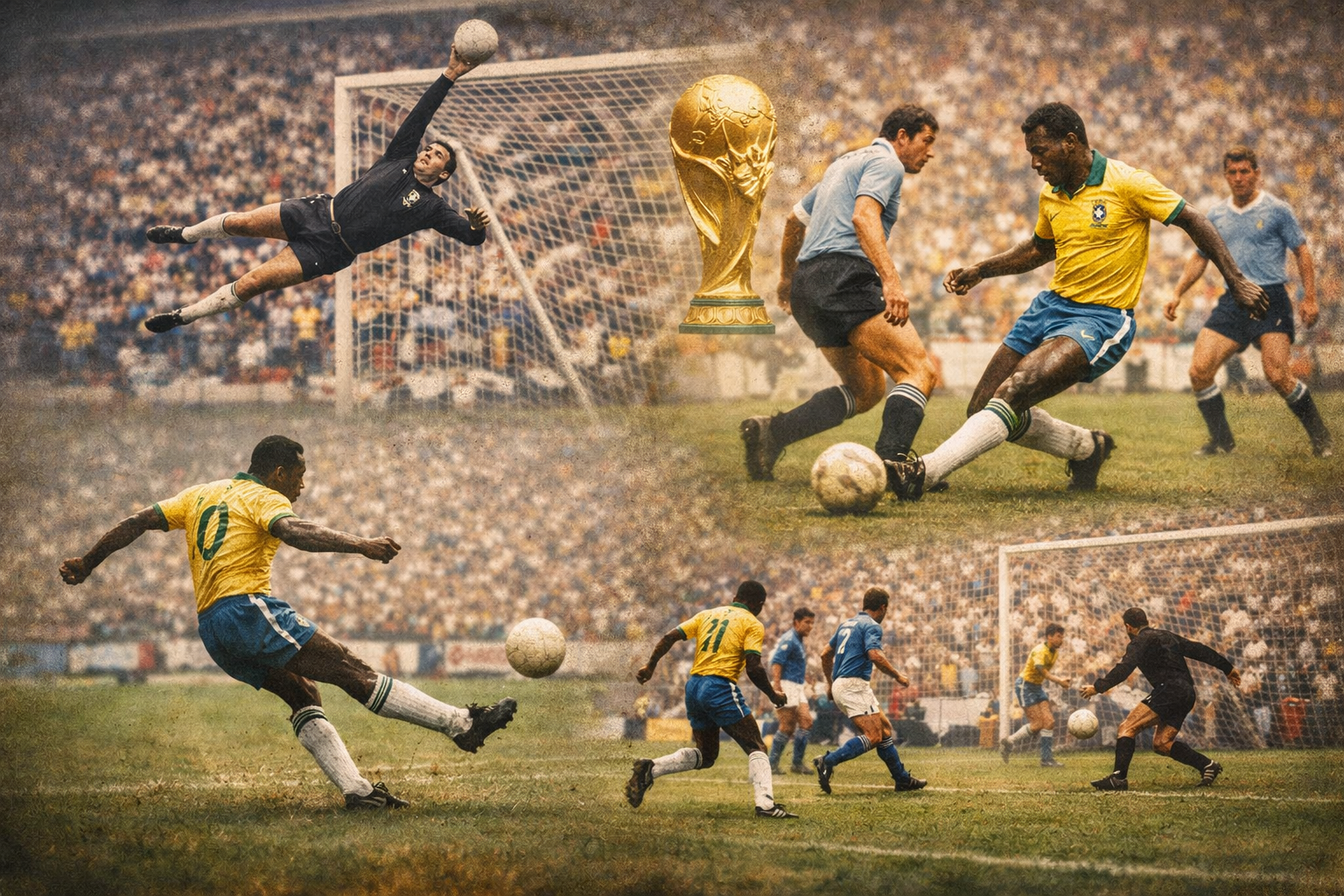
The 1970 World Cup lives in football memory like a film restored in perfect colour. Mexico’s bright light, the gold of Brazil, the crackle of old commentary, and a team so gifted it still feels half-mythical more than half a century later.
At the centre of it all was Pelé.
That much is obvious. Ask almost anyone to name the player most closely tied to that tournament and the answer arrives instantly. Brazil won the trophy, Jairzinho scored in every game, Tostão knitted attacks together, Rivellino dazzled, Carlos Alberto supplied the iconic finish in the final — but Pelé remained the image that survived longest.
What is striking, though, is how he is remembered.
For many World Cups, one forward and one goal become inseparable. Geoff Hurst in 1966. Gerd Müller in 1974. Mario Kempes in 1978. Diego Maradona in 1986. The tournament mythology usually settles around the finish, the net bulge, the split-second that decides history.
With Pelé in 1970, it is different. Yes, he scored four goals and captained Brazil’s imagination as they claimed a third world title. But the tournament’s most enduring Pelé memories are not only goals. Some are misses. Some are saves. Some are moments of vision so audacious they matter just as much as anything that crossed the line.
That is part of why his Mexico 70 story still feels larger than statistics, even though the statistics are absurd enough on their own.
Pelé’s record for Santos remains the stuff of football folklore, and his international output — 77 goals in 92 matches for Brazil — still reads like proof of a player operating above the level of his era. Yet numbers alone do not explain why 1970 still glows around him. The answer sits in the details: the ideas he tried, the pressure under which he tried them, and the way those attempts expanded the sense of what was possible on a football pitch.
The opening warning shot
Brazil began their tournament against Czechoslovakia, and early on Pelé missed the kind of chance you would expect him to bury. In front of goal, with the target invitingly open, he lifted the ball over the bar. For a moment, it looked like the sort of miss that would linger.
Instead, it became a footnote to something more memorable.
As the first half wore on, Pelé collected possession inside Brazil’s half, looked up and instantly noticed that goalkeeper Ivo Viktor had drifted off his line. From near the centre circle, he hit a first-time effort that almost dropped in from extraordinary distance. It flew just wide, but the miss scarcely mattered. The attempt itself was the message.
This was not showboating in a dead game. This was a World Cup opener, with the score level, under genuine pressure. Pelé saw the picture before anyone else did and backed himself to execute a solution no one else was even considering.
That effort has endured because it captured his footballing imagination in one act. The technique was exceptional, but the real marvel was the nerve. Many players can improvise in comfort. Very few do it on the biggest stage with the game still hanging in the balance.
Brazil would go on to win 4-1, and Pelé did score, but the near-miss from distance remains one of the tournament’s defining clips. It told the world that he was not just a scorer. He was an inventor.
The header that made Gordon Banks immortal
Four days later came Brazil against England, the holders, in one of the most celebrated group-stage matches the World Cup has produced.
The game was played at noon in brutal heat, and early in the first half Brazil carved England open down the right. Jairzinho beat his man and clipped a cross towards the back post. Pelé met it with a downward header that was almost perfect: powerful, precise, directed low into the corner, exactly the sort of effort forwards are taught will not be saved.
But Gordon Banks saved it.
Even now, the sequence can feel impossible. Banks had to move across his goal, react to the bounce, adjust his body shape and somehow claw the ball up and over the bar. The save has spent decades in the argument for the greatest ever, and while such labels are impossible to settle, the reason it survives is clear enough: it looked beyond saving.
Pelé did not score, yet somehow the moment added to his aura rather than diminishing it. His header was so good that the save became legendary. In a strange way, only a player of Pelé’s stature could help create an opposition goalkeeper’s immortality while preserving his own.
That match produced another enduring image too: Pelé and Bobby Moore exchanging shirts afterwards, two icons meeting with obvious mutual respect after a contest that felt heavier than a standard group game. The photograph has lasted because it carries something more than nostalgia. It captures a shared understanding between elite players who knew the level they had just reached.
Brazil won 1-0, and the result sent them towards the knockout rounds. But as with so much of Pelé’s 1970 tournament, the memory most people carry is not the scoreline. It is the moment around it.
The goal that never was against Uruguay
By the semi-final, the emotional stakes had risen even further. Uruguay were not just another opponent. They were the side that had inflicted the deepest wound in Brazilian football history by winning the 1950 World Cup decider at the Maracanã.
When Uruguay led in Guadalajara, old anxiety would have stirred. Brazil recovered, equalised, then moved ahead through Jairzinho before Rivellino eventually made the game safe. Yet the image from that semi-final is not one of the goals Brazil did score.
It is Pelé’s miss.
Late on, Tostão slid a pass through and Pelé accelerated onto it with goalkeeper Ladislao Mazurkiewicz rushing out. Most forwards would touch the ball around the keeper. Pelé chose something far more daring. Without making contact, he let the ball run past Mazurkiewicz on one side, sprinted around him on the other, collected it and shot first time.
The ball drifted agonisingly wide.
Had it gone in, it would sit in every World Cup montage ever made. Instead, it survives as one of football’s greatest almost-goals — a piece of genius separated from perfection by inches. It remains unforgettable because the move itself feels supernatural: the calm to imagine it, the timing to pull it off at speed, the theatrical sense that football could still hold one more trick.
That is the essence of Pelé in 1970. He was not merely effective. He enlarged the game’s possibilities.
The final pass in the final masterpiece
Then came Italy in the final.
Pelé opened the scoring with a towering header, a reminder that for all the poetry around his game, he still delivered in the most traditional currency available to a No. 10 or No. 9: goals. Italy equalised through Roberto Boninsegna, but Brazil’s superiority gradually asserted itself. Gérson restored the lead. Jairzinho added another.
And then football history arrived.
In the closing stages, Brazil pieced together one of the most famous team moves the sport has ever seen. The sequence began deep, flowed through midfield with that familiar Brazilian ease, and reached Jairzinho near the edge of the area. He found Pelé, who had drifted into space just outside the box.
What happened next is among the simplest and smartest actions ever seen in a World Cup final.
Pelé paused. For a split second, everything slowed. Without turning to look, he sensed Carlos Alberto tearing forward to his right. Then he rolled a perfectly weighted pass into the full-back’s path. Alberto hit it first time, low and hard, beyond the goalkeeper.
It was Brazil’s fourth goal, the final blow in a 4-1 win, and the perfect expression of what that side represented: fluency, movement, trust and technique at full speed.
The finish belonged to Carlos Alberto, but Pelé’s role is what keeps the move so magnetic. He did not need extra touches. He did not need spectacle for its own sake. He simply understood the geometry of the moment before everyone else and released the ball at exactly the right time.
For a player so often framed first as a goalscorer, it was a pass that became one of the signature images of his career.
Why 1970 still belongs to Pelé
Brazil’s 1970 side has a compelling claim to being the greatest international team ever assembled. The balance of the lineup, the technical level, the rhythm of their attacks and the scale of the stage all feed that argument. They won every match. They entertained. They left behind not just a trophy but an aesthetic standard.
Within that team, Pelé still stood out.
Not simply because he scored in the final, or because he ended the tournament with four goals, or because he was already a global superstar by then. He stood out because he seemed to compress every possible version of attacking greatness into one tournament.
He was clinical enough to score. Powerful enough to dominate in the air. Creative enough to shape the final with a pass. Visionary enough to attempt a lob from distance. Bold enough to turn a one-on-one into an improvisational masterpiece. Good enough that an all-time save was required to stop him.
That is why the memories beyond the goals matter. They reveal the full width of his game.
Plenty of great forwards leave tournaments with one defining finish. Pelé left Mexico in 1970 with something rarer: a gallery of moments that explained his genius from every angle. The goals are part of the story, of course. They always are with Pelé.
But the legend endures because he gave the World Cup more than goals. He gave it imagination, risk, theatre and the sense that the game’s biggest stage was still not quite big enough to contain him.