
How VAR is quietly reshaping the modern game
Video review is still judged by delays and controversy, but its biggest impact may be the way teams attack, defend and build squads.
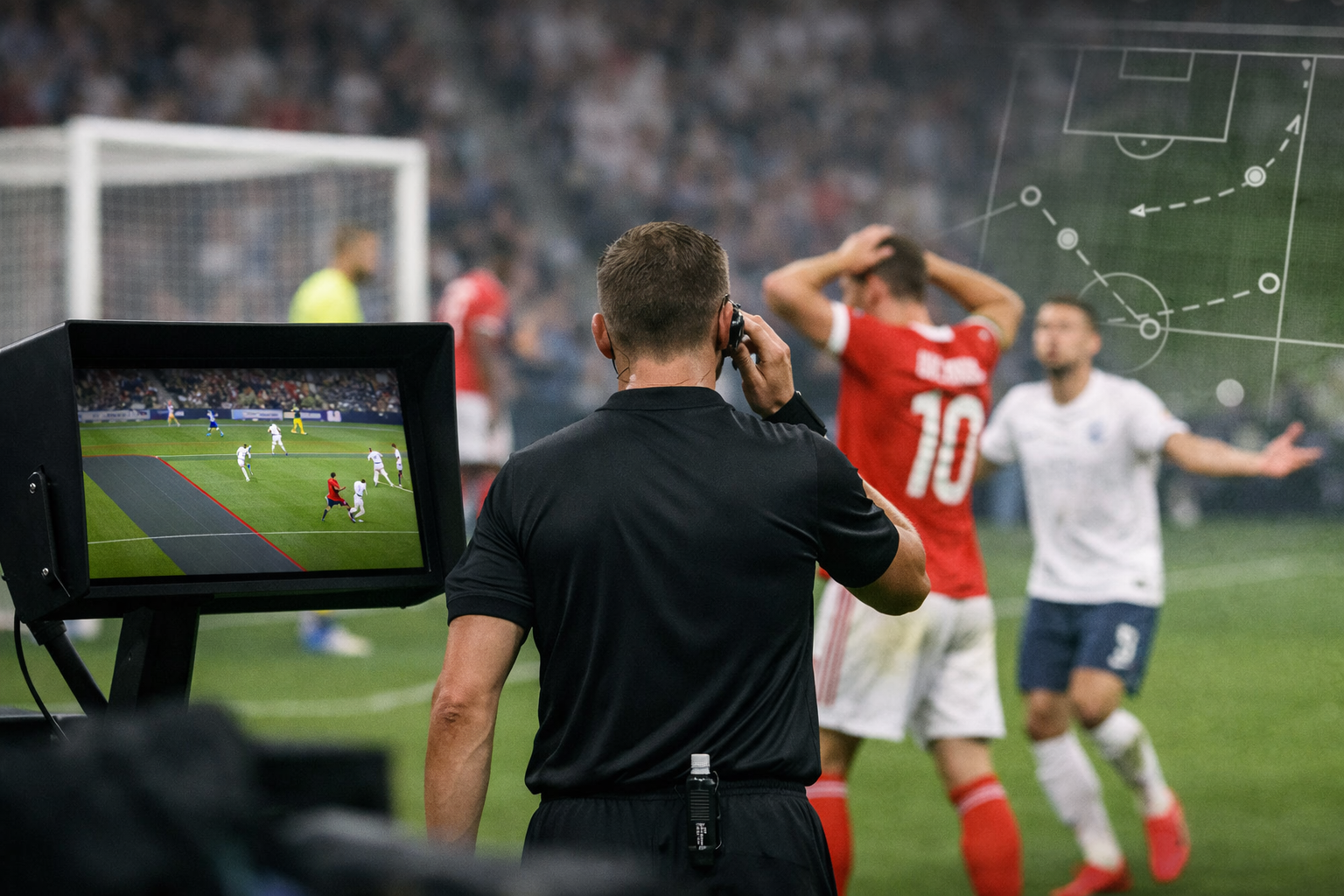
Video assistant refereeing is normally debated in the same familiar ways. Supporters talk about long stoppages, marginal offsides, ruined celebrations and whether the right call was actually made. Those arguments are understandable, but they can also miss a bigger point.
VAR has not only changed decision-making. It has changed football itself.
As with any law adjustment in a sport as layered as soccer, the consequences have spread far beyond the original aim. Football rarely allows for isolated reform. Tweak one part of the game and another area shifts with it.
A useful historical comparison is the move to three points for a win. The idea behind it was simple: reward ambition and create more attacking football. Yet the effects were more complicated than the slogan suggested. Teams that went ahead often became even more desperate to protect the lead they had earned. The game did not simply become more open; it also became more cynical in key moments.
VAR has produced a similar chain reaction. It may reduce some obvious errors, but it has also influenced tactical choices, player profiles and even the value of certain phases of play.
Offside has become harsher in practice
One of the clearest changes concerns offside.
For decades, the law said an attacker level with the second-last defender was onside. In theory that remained true, but in real match conditions assistants had to make split-second calls with the naked eye. Because of that limitation, attackers often received a small practical margin. If a forward was inches beyond the line, there was a fair chance the flag would stay down. Defenders understood this and knew they needed a visibly clean line to rely on an offside trap.
VAR has effectively wiped out that margin.
Now, goals and major attacking moments can be checked frame by frame. A striker can be ruled out by the tiniest body-part advantage, the kind of separation no assistant referee could reliably identify in real time. The result is that “level” still exists in the wording of the law, but it has become much narrower in reality.
That matters because runs in behind are harder to execute. The old poacher, the striker who lived on anticipation, half-steps and instinctive movement near the shoulder of the last defender, has a smaller operating window than before. The elite game has become less forgiving for that type of penalty-box predator.
It is not the only reason, but it helps explain why the center-forward market has begun to tilt toward more traditional No. 9s again. Recent high-profile movement involving players such as Alexander Isak, Benjamin Sesko, Viktor Gyokeres, Hugo Ekitike and Nick Woltemade has added to the sense that top clubs once again want bigger, more complete central forwards. With Erling Haaland already setting the benchmark, there is a renewed appetite for strikers who can occupy defenders physically, link play and attack crosses rather than rely primarily on razor-thin timing behind the back line.
That does not mean the old-style poacher has vanished entirely. But the environment is less favorable to him than it once was.
Where attackers have gained an advantage
If VAR has made one part of life harder for forwards, it has made another part easier.
The imbalance appears most clearly at set-pieces.
VAR reviews goals. It checks possible penalties. But it does not operate as a full reset on every piece of contact in the penalty area, especially when the outcome would be a defensive free-kick rather than an attacking one. That creates an uneven risk structure.
When a corner or wide free-kick is delivered, attackers know they can engage in a considerable amount of blocking, grappling and obstruction with limited danger. At worst, they might concede a free-kick that often goes unnoticed unless the referee spots it live. Defenders, on the other hand, are operating under a more severe threat. If they pull, grab or wrestle and the ball situation develops into a possible scoring chance, VAR can intervene and award a penalty.
That asymmetry changes behavior.
Attackers can be more aggressive in trying to create separation. Defenders know that the same physical contest carries a much higher cost for them. The result is a system that naturally leans toward the attacking side during dead-ball situations.
The set-piece boom is not an accident
This helps explain why set-pieces have become even more valuable in modern soccer.
Of course, their rise is also connected to better coaching, improved data analysis and increasingly sophisticated routines. But VAR has amplified the trend. Coaches know that chaos in the box now favors the attacking team more than it used to. Blocking runs can disrupt markers. Small holds can delay defenders. And if defenders respond in kind, they run the risk of conceding a penalty after review.
So the incentive is obvious: put the ball into dangerous areas, crowd the six-yard box, create contact and force officials into difficult judgments.
Even when a goal is eventually scored from a set-piece, the threshold for overturning the attacking side’s physical work often feels high. Defenders can sense they are being watched by a system much more likely to punish their contact than the attacker’s.
That has tactical consequences across the sport. More clubs now devote major training time to dead-ball routines, not only because of their baseline value but because the officiating environment makes them even more rewarding.
Why consistency is more complicated than it sounds
Defenders of VAR will argue, with some justification, that the game now contains fewer clear mistakes in decisive moments. That is a fair point. But accuracy is not the only question.
The issue is also structural consistency.
A notable problem is that VAR is highly selective in what it is allowed to review. It does not evaluate every foul in a penalty area with equal scope. It is designed around specific trigger moments: goals, penalties, red cards and mistaken identity. That means two very similar incidents can occur in the same passage and only one is truly reviewable because of what it might lead to.
This creates strange outcomes.
Consider a situation where both an attacker and defender are engaged in near-identical wrestling inside the box. If the defender’s foul is tied to a potential penalty, that action can be revisited and punished. If the attacker’s foul would have led only to a defensive free-kick, it may escape review entirely. The technology may therefore produce a decision that is technically valid within the protocol while still feeling incomplete or unfair in football terms.
That distinction matters. It does not mean officials are applying different laws. It means the review system itself shines its spotlight unevenly.
A different rhythm, a different sport
The other major cost is one fans already feel instinctively: rhythm.
Soccer has always relied on flow. Its emotional force comes from continuity, from transitions that unfold before players or supporters fully process them. VAR interrupts that natural pace. Sometimes the stoppage is brief; sometimes it drags. Either way, the modern match has more pauses, more uncertainty and more moments where instinct gives way to administration.
That change is not merely aesthetic. It alters player psychology. Teams know attacks can be retrospectively checked, goals can be delayed and physical duels can be reinterpreted moments later. The sport becomes slightly more cautious, slightly more fragmented.
At the same time, dead-ball moments become more central, because they are more controllable, more rehearsed and more likely to bring VAR into play.
The bigger question for the game
This is the real debate soccer has to confront.
If VAR delivers more correct calls overall, many will say the trade-off is worth making. Others will counter that precision has come at the expense of spontaneity, fluency and balance between attack and defense.
What is no longer believable is the idea that VAR is just a neutral correction tool sitting above the sport. It is part of the sport now. It shapes recruitment. It shapes tactics. It shapes defending at corners and the timing of runs beyond the back line. It shapes what kinds of strikers prosper and which moments decide matches.
In other words, VAR is not only refereeing football. It is helping redefine it.
And that leaves the sport with a difficult but necessary question: how much transformation is acceptable in the pursuit of greater accuracy?