
How Real Madrid Closed Out La Liga: Benzema, Ramos, Courtois and Zidane Drove Title No. 34
Real Madrid’s 2020 league triumph was built on control rather than chaos, with Karim Benzema’s class, Sergio Ramos’ authority, Thibaut Courtois’ resilience and Zinedine Zidane’s management defining the run-in.
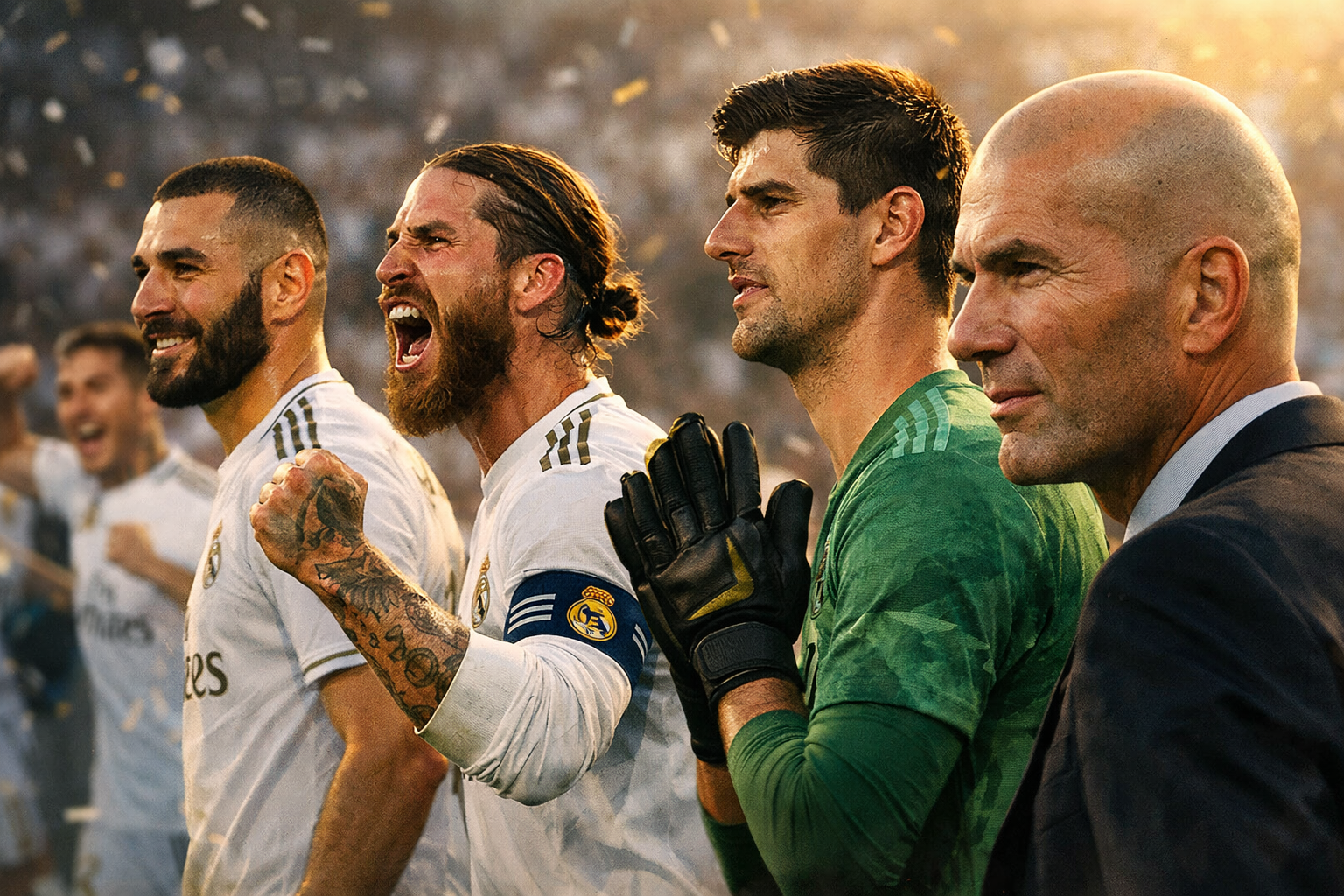
Real Madrid’s 34th league title did not arrive in the usual way. There were no packed stands, no roaring Bernabéu, no city-centre scenes to frame the moment. The trophy was secured in the strange, closed-door reality of pandemic football, with the celebrations naturally feeling muted compared to the scale of the achievement.
But if the setting was unusual, the logic of the title win was not. Madrid were the most controlled, most durable side in Spain when the season entered its decisive stretch. Once La Liga restarted, Zidane’s team turned the run-in into an exercise in game management. They won 10 straight league matches before easing to a draw with Leganés after the title had already been sealed. They did not need spectacle every week. They needed margins, discipline and a handful of elite figures to tilt tight games their way.
That was the pattern of this title race. Madrid did not always dazzle, and they rarely needed to. They simply became extremely difficult to beat. In a season where Barcelona kept leaving the door open, Real Madrid were the side best equipped to walk through it.
Four names, in particular, sit at the centre of that story: Karim Benzema, Thibaut Courtois, Sergio Ramos and Zinedine Zidane.
Benzema became the reference point
If one player gave Madrid a reliable attacking identity, it was Karim Benzema.
This was the campaign where his influence became impossible to reduce to old narratives about sacrifice, link play or doing the work others get credit for. Benzema had long been appreciated by coaches and teammates for the subtle parts of centre-forward play: dropping into pockets, combining in tight spaces, opening lanes for runners, choosing the right pass a beat before everyone else sees it. This time, he paired all of that with decisive output.
He finished the league season with 21 goals and eight assists, leading Madrid in both categories. In a side that did not get enough from Eden Hazard and lacked consistent production from several wide options, Benzema became the attacking safety net and the creative hub at once.
That dual role mattered. Real Madrid were not blowing opponents away through volume. They were often winning narrow games where one moment of quality was enough to change the script. Benzema supplied those moments repeatedly.
His brilliant finish against Valencia stood out as one of the league’s most memorable goals of the season, but his campaign was about more than highlight clips. The backheeled assist for Casemiro against Espanyol captured his game even better: awareness, technique and the speed of thought to execute something difficult as if it were obvious.
That has always been Benzema’s gift. He sees attacking football with rare clarity. The difference in this title run was that his elegance was matched by cold numbers. Without Cristiano Ronaldo still occupying the centre of Madrid’s universe, Benzema moved fully into the spotlight and looked entirely comfortable there.
For years, his value had to be explained. In this title-winning side, it was visible every week.
Courtois anchored the defensive shift
At the other end, Madrid’s title was built on a defensive standard that became the clearest tactical signature of their season.
They conceded only 25 league goals, the best record in the division, and Thibaut Courtois was central to that transformation.
That was not an obvious storyline early on. Courtois had come under heavy scrutiny in his first period at the club, and confidence around him had looked fragile at points. Yet by the end of the campaign, he had re-established himself as one of the most decisive goalkeepers in Spain and a major reason Madrid kept collecting one-goal wins after the restart.
That post-lockdown stretch is where his season takes on full importance. Six of Madrid’s 10 straight victories were won by a single goal. In those games, the goalkeeper is not a supporting character. He is often the difference between control and dropped points.
Courtois made that difference repeatedly.
There were saves that preserved momentum when matches were still level, and others that protected narrow leads late on. Against Valencia, with the title race still under real pressure, he produced a vital stop to keep the game scoreless before Madrid took control. Against Villarreal, on the night the title was sealed, he delivered late saves that underlined how secure he had become.
By the finish, the individual recognition followed. Courtois claimed the Zamora Trophy for the league’s best goals-conceded ratio, a fitting reward for a season in which he did much more than recover from a difficult start. He became one of the pillars of the team.
Madrid’s defenders deserve credit for the structure in front of him, but the title was shaped by the reality that opponents increasingly needed a near-perfect moment to beat him. Most did not find one.
Ramos still decided the biggest moments
Few footballers are as polarising as Sergio Ramos, but few are as consistently decisive in title races either.
By this stage of his career, questions around him were understandable. He was in his mid-thirties, his defending was scrutinised more closely, and every lapse seemed to feed a wider argument about decline. But the defining truth of Ramos has always been this: when a season sharpens and the pressure rises, he has an unmatched ability to impose himself on the outcome.
That happened again here.
Ramos finished the campaign with 11 league goals, an extraordinary return for a central defender and one that underlined how much he contributed beyond pure defensive work. Many of those goals came from the penalty spot, but that should not diminish their value. Penalties in a title run are pressure moments, and Ramos has long treated pressure like a stage rather than a burden.
His influence, though, was not only about goals. It was in the emotional shape of the team, in the sense that Madrid had a captain willing to drag difficult games toward the result they needed. There were interventions in open play, last-ditch defensive actions and the familiar sense of authority he brings to high-stakes matches.
Even in a season where some imperfections were visible, Ramos remained indispensable because he gave Madrid certainty in decisive moments. That matters enormously in a league campaign decided by slim margins.
He may divide opinion outside the club, but within a title race he is exactly the kind of player every contender wants: experienced, confrontational, fearless and productive.
Zidane made Madrid pragmatic enough to win
If Benzema defined the attack, Courtois stabilised the last line and Ramos set the emotional tone, Zidane was the figure who connected everything.
This league title strengthened his managerial case in a different way from his first major successes. There was no Ronaldo to frame the conversation this time. There was no easy argument that Madrid were simply being carried by one unstoppable superstar. Instead, Zidane had to build a team with flaws, manage fitness through a disrupted season and steer a squad through a compressed run-in where rotation, trust and emotional control mattered as much as tactical planning.
He got that balance right.
Zidane’s Madrid were flexible rather than doctrinaire. They did not play one way at all times, and that has sometimes been used against him in debates about elite coaching. But adaptability was a strength in this campaign, not a weakness. He read situations, used his squad intelligently and accepted that this team did not need to dominate every game aesthetically to dominate the table.
That point is crucial. After a bruising pre-season, including a heavy defeat to Atlético Madrid, Zidane leaned into solidity. Madrid became harder to break, more patient in possession and more comfortable winning ugly when required. In a normal season, fans may crave sustained brilliance. In a title race decided over tight, tense weeks, pragmatism wins matches.
He also kept a deep squad involved. Different players contributed across the campaign, and that rotation was not decorative. It allowed Madrid to maintain energy and concentration at the moment the title race became a sprint.
The result was a team that looked mentally settled. They rarely chased games because they so rarely put themselves in that position. They protected leads, controlled tempo and trusted that one key intervention would usually arrive.
That is coaching too. Not just systems on a whiteboard, but collective belief, role clarity and the management of elite personalities over a long season.
A title built on control
Real Madrid’s 34th La Liga crown was not about overwhelming the league with relentless attacking football. It was about mastering the rhythms of a complicated season and owning the margins better than anyone else.
Benzema gave them quality when attacking inspiration was needed. Courtois turned close games into wins. Ramos supplied leadership and decisive interventions. Zidane made the whole machine coherent.
In the end, that combination was enough to carry Madrid past Barcelona and over the line.
The celebrations may have looked different, stripped of the grand public backdrop usually attached to titles at this club. The achievement itself, though, was unmistakably Real Madrid: elite individuals, a manager who understood the pressure, and a team that found its most ruthless version at exactly the right time.