
Edmundo: Brazil’s Brilliant, Unruly ‘Animal’ and the Career Defined by Contradictions
A dazzling forward with a ferocious edge, Edmundo mixed elite talent with chaos, building one of Brazilian soccer’s most unforgettable and troubled careers.
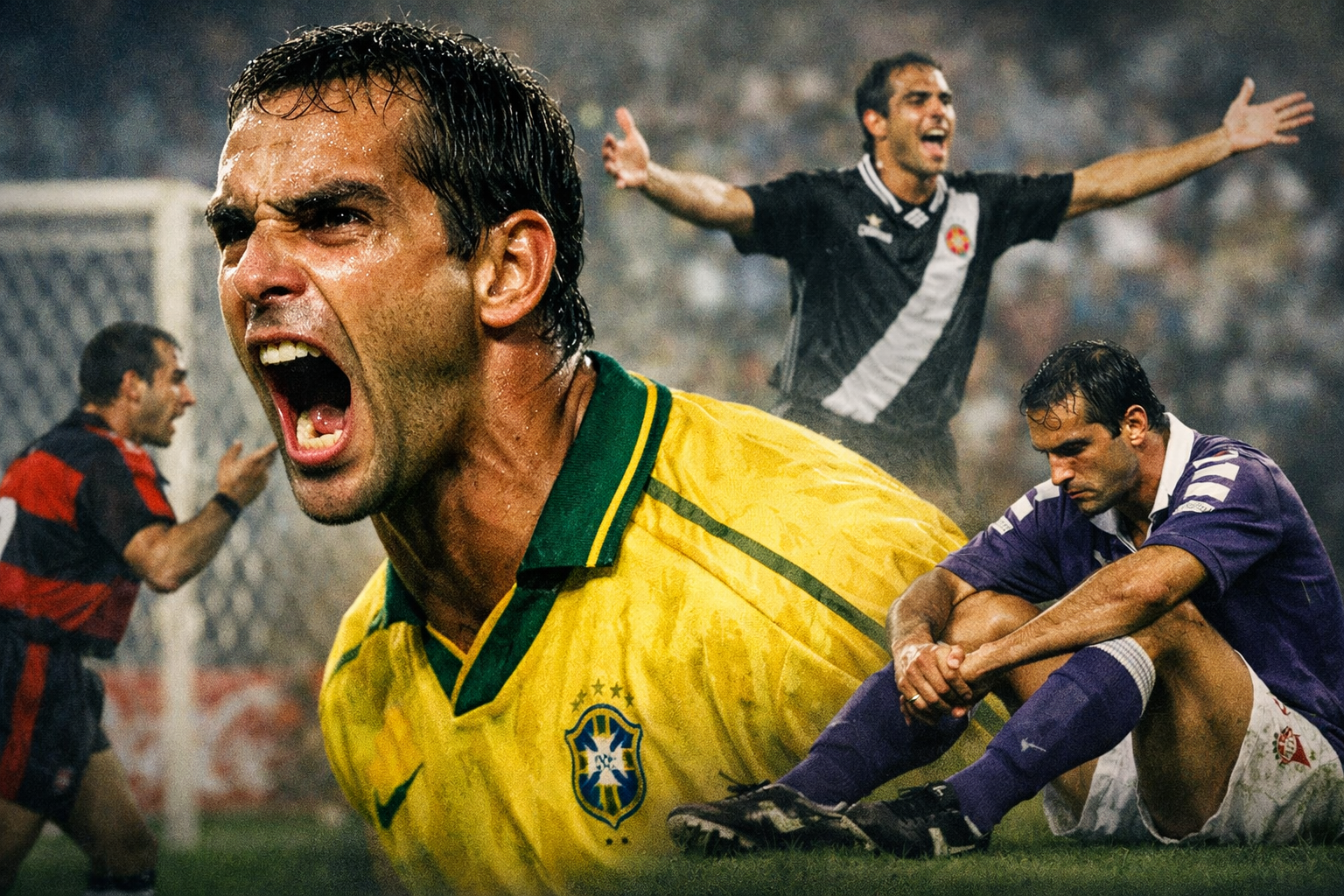
Few Brazilian forwards have embodied contradiction quite like Edmundo. He could decide matches with a flash of genius, unsettle entire defenses with his dribbling, and produce goals that seemed to belong to a different level of imagination. Yet the same player repeatedly sabotaged himself with rage, impulsiveness and off-field turmoil.
Known across Brazil as “O Animal”, Edmundo Alves de Souza Neto remains one of the most gifted and combustible figures the country has produced. His story is not a straightforward rise from hardship to glory. It is instead the portrait of a footballer whose immense talent was matched, and too often undermined, by a reckless streak that followed him everywhere.
Beginnings in Rio’s orbit
Edmundo’s path started far from the glamorous image often attached to Brazilian football. He grew up in Niterói, across Guanabara Bay from Rio de Janeiro, in a family working hard to get by. His father was a barber, his mother a cleaner, and like many children in that environment, he found his space in informal games played wherever there was room for a ball.
Football quickly became more than a pastime. It was the center of his life.
As a child, Edmundo was already known for two traits that would define his career: dazzling skill and a fierce temper. Small in stature but overflowing with confidence, he played with the swagger of someone certain he belonged on a bigger stage. Family members helped nurture that dream, especially an aunt who took him to training and to matches involving Vasco da Gama, the club he loved.
His first significant opening came with Botafogo’s youth setup. Coaches recognized the raw quality immediately, but trouble appeared just as quickly. During his time in the club environment, he was reportedly expelled from youth lodging after a bizarre disciplinary incident. That would become a recurring pattern in his life: doors opened by talent, then threatened by behavior.
Vasco launch a star
If Botafogo was an early false start, Vasco became the place where Edmundo truly emerged. A spectacular youth goal helped reinforce the sense that he was no ordinary prospect, and by early 1992 he had made his first-team debut.
The impact was swift. Vasco won the Carioca title that year, and Edmundo looked like one of Brazil’s next major attacking forces. He formed an exciting partnership with Bebeto, and supporters saw in him a player capable of unsettling any defense with his direct running and fearless style.
But even as his reputation grew, so did concerns about his temperament. Edmundo was never a quiet dressing-room figure. He played with edge, spoke with edge, and clashed with people around him when things did not go his way. His football invited admiration; his volatility invited worry.
Palmeiras, trophies and turmoil
In the early 1990s, Palmeiras were being transformed by major investment and ambitious squad building. Vanderlei Luxemburgo was assembling what would become one of the strongest sides in Brazilian football, and Edmundo’s arrival for a record fee made headlines.
At Palmeiras, the football side of his legend expanded dramatically. Surrounded by elite talent, he helped drive the club to back-to-back Brasileirão titles and a state championship. He was decisive, electrifying and often impossible to stop.
This was also the period when the nickname “O Animal” took hold, a label that captured both his aggressive playing style and his increasingly turbulent image.
On the field, incidents piled up alongside the trophies. He was sent off repeatedly, fought with opponents, argued with referees and even clashed with teammates. One infamous match against São Paulo spiraled into mass confrontation after Edmundo reacted furiously to a tackle, lashed out at multiple opponents and helped trigger a melee that ended with several dismissals.
He could win games almost single-handedly. He could also turn them into chaos.
That duality made him compelling but deeply unreliable. Even while delivering silverware, he seemed unable to stay clear of self-inflicted damage.
Flamengo and tragedy off the pitch
After success with Palmeiras, Edmundo returned to Rio to join Flamengo, where he was expected to be part of a fearsome attacking line with Romário and Sávio. On paper, it looked like one of the most exciting combinations in South American soccer.
In practice, the project never fully came together. Flamengo struggled, and Edmundo remained a magnet for controversy.
Then came the darkest episode of his life.
In December 1995, after a night out during carnival festivities, Edmundo was involved in a car crash in Rio de Janeiro that killed three people. He was charged with involuntary manslaughter. The consequences were immediate and devastating, both legally and professionally. Flamengo terminated his contract, and the case cast a shadow over the rest of his life and career.
This was no longer simply the story of a hot-headed footballer wasting potential. It became the story of irreversible tragedy, guilt and public condemnation.
A return to football and a peak at Vasco
Even after the crash, clubs were still willing to bet on his ability. A brief move to Corinthians went nowhere, and Vasco eventually brought him back.
On the pitch, he produced what many consider the finest season of his career. He exploded as a scorer, breaking the Brazilian league scoring record with 29 goals in a single campaign. It was a reminder that for all the instability, Edmundo’s talent remained extraordinary.
His form forced his way into national-team discussions ahead of the 1998 World Cup. Some believed he had done enough to start for Brazil. Coach Mário Zagallo, however, was wary of the disruption he could bring to the squad.
That concern proved understandable. During the tournament, Edmundo voiced frustration over his lack of minutes, even taking his complaints public. He did make the final squad and seemed close to a bigger role when Ronaldo suffered his frightening pre-final medical episode, but Brazil ultimately returned to its superstar striker for the final.
Edmundo’s World Cup became another chapter in the same pattern: elite ability, overshadowed by tension and noise.
Fiorentina and a lost chance in Italy
A move to Fiorentina offered him a fresh setting and a major European challenge. In Florence, he joined a dangerous attacking cast alongside Gabriel Batistuta and Rui Costa. For a time, it looked like the perfect fit. Fiorentina surged to the top of Serie A, and Edmundo’s flair gave the side another level of unpredictability.
Then came one of the most damaging decisions of his career.
With Batistuta injured and Fiorentina in a real title race, Edmundo chose to exercise a contractual clause that allowed him to return to Brazil for carnival. The timing stunned teammates and infuriated supporters. Fiorentina’s momentum faded, and the club fell out of the Scudetto race.
The episode reinforced his reputation internationally. He was not just volatile. He was capable of making choices that placed impulse above team ambition at the very moment he was needed most.
Back home, more brilliance and more friction
Edmundo eventually returned to Vasco, where his connection with the club and its fans remained powerful. But peace was never guaranteed, especially after Romário arrived.
The two stars had a complicated history and their relationship became one of Brazilian football’s most talked-about feuds. Even so, they could combine devastatingly on the pitch. Their most famous performance together came in January 2000, when Vasco beat Manchester United in the inaugural FIFA Club World Championship in Brazil.
Edmundo scored a brilliant goal that night, a moment that captured the best of him: quick feet, sharp improvisation, confidence under pressure. It was the kind of finish that reminded everyone why he remained such a fascinating player despite everything that surrounded him.
But even that high did not last. In the final of the same tournament, he missed a decisive penalty as Vasco fell to Corinthians. He later described it as the worst moment of his career.
From there, his time at the top gradually ebbed away.
The final years and lasting image
Edmundo spent later years moving through a series of shorter spells, including more returns to clubs that already knew both his gifts and his flaws. He never again sustained the same level of impact that had once made him one of Brazil’s most feared forwards.
Personal pain continued to follow him. In 2002, his brother was found dead in Rio de Janeiro, another tragedy added to an already heavy life story.
The legal case stemming from the 1995 crash remained unresolved for years before a 2011 ruling determined that the statute of limitations had expired. Though the legal threat ended, Edmundo has spoken publicly about carrying enduring remorse. That burden never disappeared.
A legacy impossible to simplify
Edmundo’s place in football history is difficult to frame neatly. He was not merely a gifted striker with a bad temper, nor simply a cautionary tale about wasted potential. He was both spectacular and destructive, unforgettable for reasons that include genius, violence, charisma, scandal and sorrow.
At his best, he was one of the most naturally talented attacking players of his generation in Brazil. He could lead a title-winning side, transform a match through individual brilliance and produce moments that still live vividly in the memory of fans.
At his worst, he became the clearest example of how instability can derail greatness.
That tension is what defines Edmundo. His career cannot be told honestly as a triumph, but neither can it be dismissed without acknowledging the rare quality he possessed. Brazilian soccer has produced many icons. Very few have been as magnetic, as divisive, or as self-defeating as O Animal.