
2026 World Cup Guide lands as football wrestles with its biggest stage
The 2026 World Cup is arriving with more teams, higher costs and louder political questions than ever before. Yet for all the noise around the tournament, the football still promises new stories, fresh debuts and one more global stage for some of the game’s enduring icons.
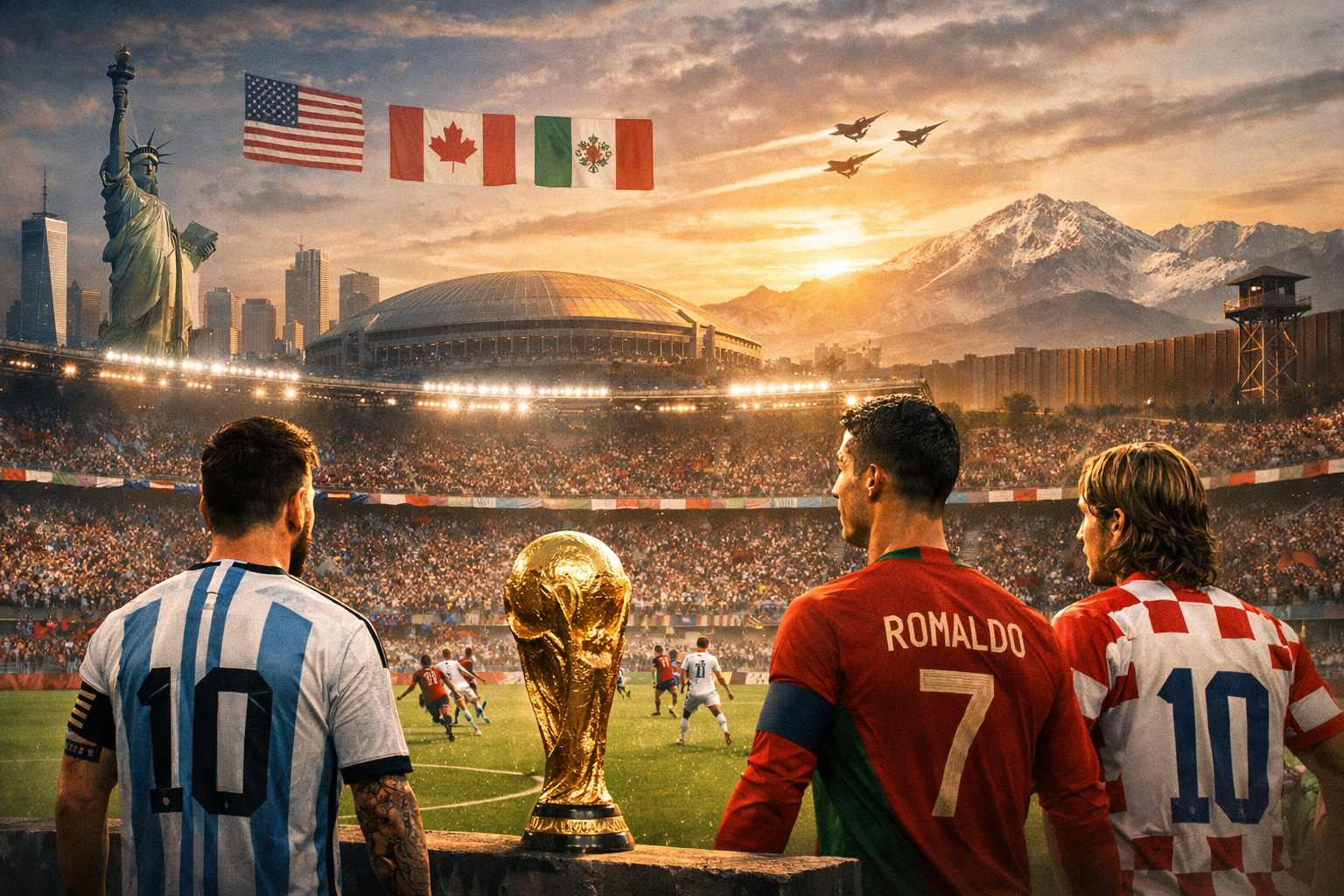
The 2026 World Cup is approaching with a strange split-screen feel. On one side sits everything that has always made the tournament football’s most magnetic event: first-time qualifiers, generational stars, tactical intrigue and the possibility of a month that reshapes careers and national sporting histories. On the other is a growing discomfort around what this edition represents off the pitch.
That tension sits at the heart of this year’s World Cup conversation. The tournament staged across the United States, Canada and Mexico should be a celebration of the game’s broadest reach. Instead, many supporters are arriving with mixed feelings.
Why this World Cup feels different
The 2026 finals are the first to expand from 32 teams to 48. In one sense, that opens the door to more nations, more players and more supporters seeing themselves on the biggest stage. In another, it raises a fair question about dilution. The World Cup has traditionally felt like a gathering of the sharpest international sides on the planet. With a larger field, the event risks feeling less exclusive and more commercially stretched.
The financial barrier has also become impossible to ignore. For many supporters, the romance of following a World Cup has collided with the practical reality of ticket prices, flights, accommodation and transport. For a tournament that trades so heavily on emotional connection, the cost of entry has become a major story in itself.
Politics has only added to the unease. FIFA’s relationship with political power has often overshadowed its own competitions, and this edition is no exception. Against a backdrop of international conflict and controversial symbolism, the World Cup has become harder to separate from the world beyond football. Rather than offering escape, it increasingly reflects the fractures around it.
Football’s showpiece has carried baggage before
None of this is entirely new. Recent World Cups have also been framed by questions that had little to do with pressing structure, finishing quality or squad balance.
The 2022 tournament in Qatar arrived under sustained scrutiny. The 2018 edition in Russia now looks even more compromised in hindsight than it did at the time. In both cases, the football still delivered moments that captured global attention, but the off-field context never fully disappeared.
That matters in 2026 because patience is thinner now. The sense of accumulation is stronger. Supporters are not only reacting to one host decision or one controversy. They are reacting to years of seeing the sport’s biggest institutions place spectacle and revenue ahead of trust.
Why the tournament still matters
And yet, for all of that, the World Cup still carries a power that few sporting events can match.
It remains the place where football can compress history into a few summer weeks. One goal can transform a player into a national icon. One upset can alter how a country sees itself in the sport. One great run can enter folklore permanently.
That is why the competition still matters even when FIFA tests the goodwill around it. The World Cup is bigger than the administrators who package it. Bigger than the politics attached to it. Bigger than the executives and opportunists trying to profit from it.
For supporters, that distinction is important. Disillusionment with the people running the game does not automatically cancel the emotional pull of the game itself. A fan can be sceptical about the structure around the tournament and still care deeply about what happens once the whistle blows.
New faces, new countries, new stories
One reason this edition retains its pull is the range of fresh stories built into the field.
The expanded format creates space for nations chasing their first real World Cup moment. Countries such as Cape Verde, Curacao, Jordan and Uzbekistan are among those set to bring something different to the tournament conversation. That matters. The World Cup is at its strongest when it does not feel closed off to the same familiar powers.
There is also an individual dimension to that freshness. Some of the game’s elite players are still waiting for a first appearance at the finals. Erling Haaland is one of the headline names in that category. Michael Olise could also arrive on this stage for the first time, while Lamine Yamal may yet turn a breakthrough club rise into a defining international summer if fitness allows.
On the touchline, there is another layer of intrigue. Coaches with the biggest club credentials do not always translate that authority into tournament football, but the presence of figures such as Carlo Ancelotti and Thomas Tuchel adds weight to the managerial subplot. International football strips away training-ground control and asks for fast, clear solutions. That has always made World Cups a revealing test for elite coaches.
The possible final bow for an era
If 2026 will introduce new names, it may also close the chapter on some of the most familiar ones.
There is a strong chance this tournament becomes the final major international appearance for Lionel Messi, Cristiano Ronaldo and Luka Modric. Football has taught us to be cautious with farewell predictions, especially when it comes to players who keep extending the boundaries of elite longevity. Still, the possibility gives this World Cup an extra emotional charge.
These are not just great players. They are reference points for an entire generation of supporters. Their presence links this competition to the World Cups many fans grew up with. If this is the last act, every minute they play will carry added meaning.
That mixture of arrival and departure is part of what gives the tournament shape. Newcomers try to force open the future while established legends resist the closing of their own era.
What the guide sets out to do
The purpose of a strong World Cup guide is not to ignore the uncertainty around the tournament. It is to acknowledge it, then help readers understand the football clearly enough to follow what comes next.
This edition aims to do exactly that. It includes team-by-team coverage of every nation expected to feature at the tournament, with each profile built around practical detail rather than vague preview language.
Readers can expect:
- A complete guide to all 48 competing teams
- Tactical analysis for each nation
- Predicted starting XIs
- Projected 26-man squads
- Coaching profiles
- Match schedules for the tournament
- Manager Q&A features where available
That depth matters because the World Cup moves fast. Once the group stage begins, narratives form quickly and often harden before casual viewers have had time to understand the teams involved. A useful guide gives context before the noise starts.
There is also an understandable caveat attached to any projection this far out. Injuries, form, late friendlies and managerial decisions can all reshape a squad list before opening day. Predicted rosters are not final rosters. But informed forecasting still helps frame the tactical identity and likely selection trends of each side.
Uncertainty remains part of the picture
One of the realities of this tournament is that not every storyline is settled even close to kickoff.
Iran are included in the guide, for example, though their status has been complicated by the broader geopolitical climate. That uncertainty underlines the central contradiction of the 2026 World Cup: football preparation is continuing even while events beyond football threaten to reshape the competition’s context.
That does not make analysis pointless. If anything, it makes careful, up-to-date coverage more valuable. The closer a tournament sits to real-world instability, the more important it becomes to separate confirmed information from assumption.
The football still gets the final word
For all the concerns around cost, politics and expansion, the core truth remains familiar. Once the tournament starts, it will produce stories nobody can script in advance.
A favourite will wobble. An underdog will land a result that changes a group. A young player will announce himself globally. A veteran may summon one last great performance. By the time the final is played on July 19, the competition will have created a new set of heroes, villains, disappointments and memories.
That is what the World Cup does, even when the build-up feels compromised. It absorbs contradiction and still finds a way to matter.
The 2026 edition may be carrying more baggage than most, but it also arrives with the same underlying promise that has always defined this tournament. Somewhere inside the scale, noise and commercial overload, there is still football capable of gripping the world.
And that, ultimately, is why a guide like this still has value. It is not a defence of everything surrounding the World Cup. It is a recognition that the game on the pitch remains worth following closely.
The tournament may not belong to the people who run it as much as they would like to think. In the moments that last, it still belongs to the players, the supporters and the stories they create together.