
Roony Bardghji left out of Sweden squad as reports point to post-qualification fallout
Swedish reports say Roony Bardghji’s omission is tied less to form than to concerns over his reaction after Sweden sealed World Cup qualification.
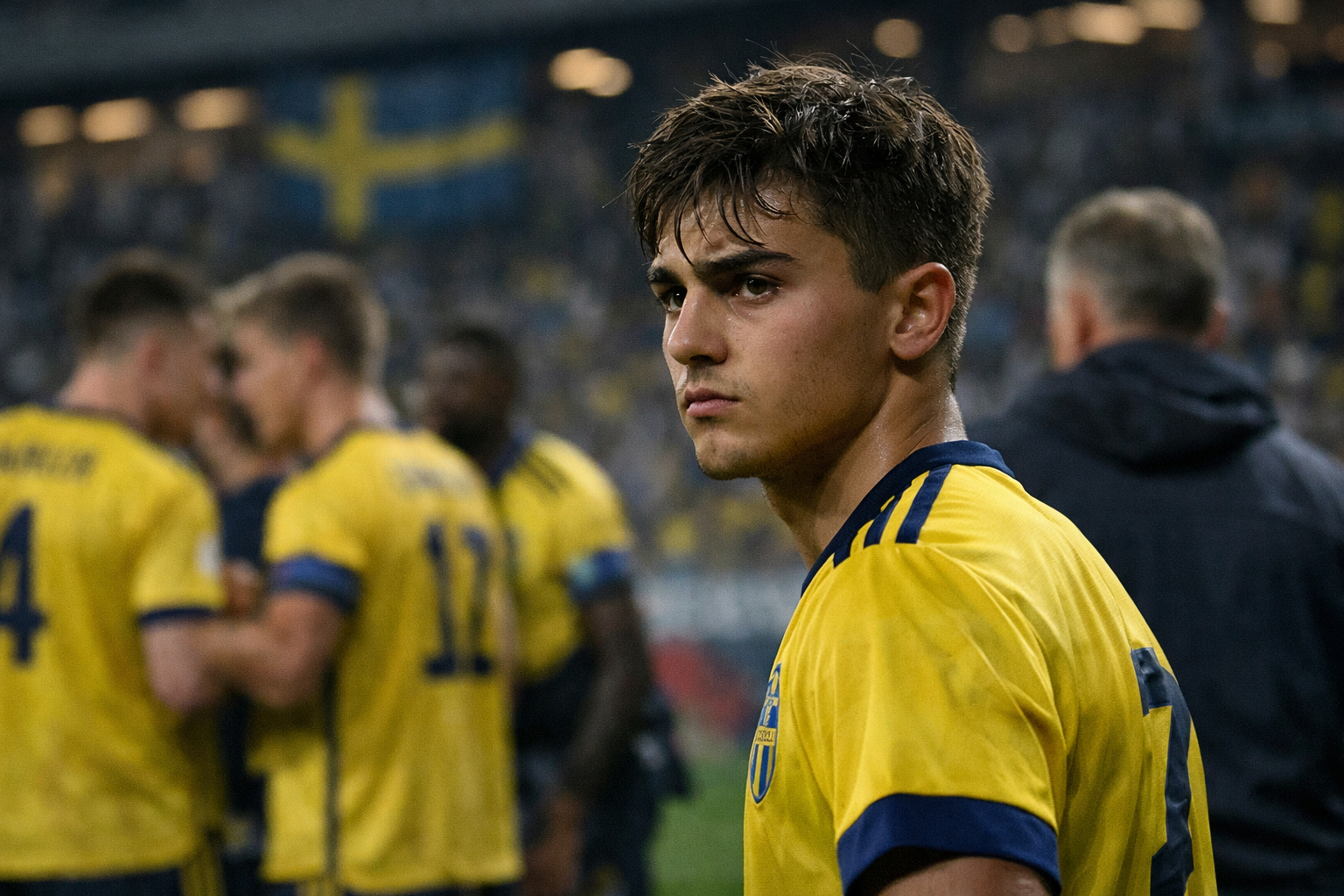
Roony Bardghji’s absence from Sweden’s latest squad has quickly become one of the biggest talking points around the national team, with reports suggesting the decision goes beyond form or minutes played at club level.
The Barcelona forward has featured in 26 matches this season, but he was left out of Graham Potter’s selection for the upcoming World Cup, scheduled to run from June 11 to July 19. On the surface, that omission is surprising enough given his profile and the attention surrounding his development. In Sweden, though, the story has taken on a sharper edge.
According to multiple Swedish outlets, Bardghji’s omission is not primarily about his performances. Instead, the focus has turned to what allegedly happened after Sweden secured qualification against Poland.
What the reports in Sweden are saying
The central claim is that Bardghji reacted badly after being left on the bench throughout the qualification-clinching match. He did not play a single minute, and reports say his frustration was visible after the final whistle despite the wider mood of celebration around the squad.
Swedish newspaper Aftonbladet reports that officials within the Swedish FA were particularly disappointed by his conduct during the post-match celebrations. The suggestion is that his response did not go down well in a moment that was supposed to be about collective achievement.
One source quoted in the reporting described the scene in blunt terms.
“It was very strange that he almost sat there in a bad mood when we had already qualified for the World Cup. It’s not beneficial at all.”
That line gives a clear indication of the issue as it is being framed internally. This is less about a tactical decision in isolation and more about how a young player is perceived inside an international setup where staff often place a huge premium on group chemistry.
Why the omission matters
Leaving out a talented young attacker is one thing. Leaving him out amid claims of tension with the squad is another entirely.
The reports suggest several players were unimpressed by Bardghji’s attitude and felt he was not fully aligned with the group in a key moment for the national team. That is a serious charge for any player, but especially for one still trying to establish himself at senior international level.
At elite international level, selection is rarely based on talent alone. Managers and federations regularly weigh personality, adaptability, patience, and dressing-room impact alongside technical ability. If Sweden’s staff believe Bardghji let personal disappointment overshadow the team’s achievement, that would help explain why this call has created such a stir.
It also points to the challenge facing young players who arrive with high expectations. Bardghji is still early in his career, but with that profile comes scrutiny. Every visible reaction is judged, and every setback can become part of a wider narrative about maturity.
A difficult season in the background
The broader context is not especially helpful for the player either. Reports describe his 2025-26 campaign as disappointing, with limited game time and growing frustration combining to create a difficult season.
Even though 26 appearances suggests some level of involvement, that number does not automatically tell a positive story. The key issue appears to be the type of role he has had and whether he has been able to build rhythm, influence matches consistently, or feel trusted in decisive moments.
That frustration appears to have spilled over during the international break. If the reporting is accurate, Sweden’s coaching staff may now be dealing with two separate concerns.
- Bardghji’s current football rhythm
- Bardghji’s reaction to not being selected or used in big moments
Taken together, that becomes a much bigger selection problem than simple form.
Graham Potter’s balancing act
For Graham Potter, this is the kind of decision that can define authority early in a national-team cycle. If he and his staff believe standards around behavior and unity need to be protected, omitting a talented player sends a strong message to the rest of the group.
International football camps are short, emotionally intense, and heavily dependent on cohesion. There is less time to smooth over tension than at club level. A squad preparing for a major tournament needs clarity, acceptance of roles, and a willingness from every player to put the team first, including those left on the bench.
That is why this case will resonate beyond Bardghji himself. Potter’s handling of it will be read as a signal of how non-negotiable those standards are.
At the same time, the manager must also avoid turning a young player’s frustration into a long-term rupture. If Bardghji remains one of Sweden’s major attacking talents, the ideal outcome for the national team would be to restore trust rather than create a permanent divide.
What happens next for Bardghji
The next step is likely to depend on what happens behind the scenes rather than in public.
If Bardghji can repair relationships inside the camp, this could still prove to be a temporary setback rather than a defining break. National teams have often reintegrated young players after moments of tension, particularly when talent levels remain high and the player shows the right response.
That response will matter.
- How he handles the disappointment publicly
- Whether he can convince staff he accepts squad roles more constructively
- How he performs at club level in the months ahead
For now, though, the omission lands as both a football decision and a disciplinary warning. It tells us that, at least based on the current reporting, Sweden’s staff and some within the squad were dissatisfied enough to make a high-profile example of a player many expected to be part of the picture.
A reminder about life inside elite squads
Bardghji’s situation is also a reminder of a broader truth in modern football. Talent opens the door, but it does not guarantee patience from teammates or coaches. In international football especially, where every camp carries pressure and every place is contested, emotional control can matter almost as much as output.
A player can be disappointed at not playing. That is normal. In many ways, coaches want ambitious players who hate being left out. The issue comes when that disappointment is seen to cut against the collective mood or the shared objective.
That appears to be the heart of this controversy.
Sweden had just qualified for the World Cup. In that context, the expectation inside the camp would have been simple: whatever individual frustrations existed, the moment belonged to the team. The reports now suggest Bardghji did not meet that expectation, and the consequences may already be affecting his international future.
Whether this becomes a short-lived lesson or a deeper rupture will depend on the next conversation, not the last celebration.