
Mbappe defends right to speak on politics as Dugarry questions timing
Kylian Mbappe says footballers remain citizens with a right to speak on France’s political climate, but Christophe Dugarry believes the France captain’s intervention could create unnecessary tension around the national team.
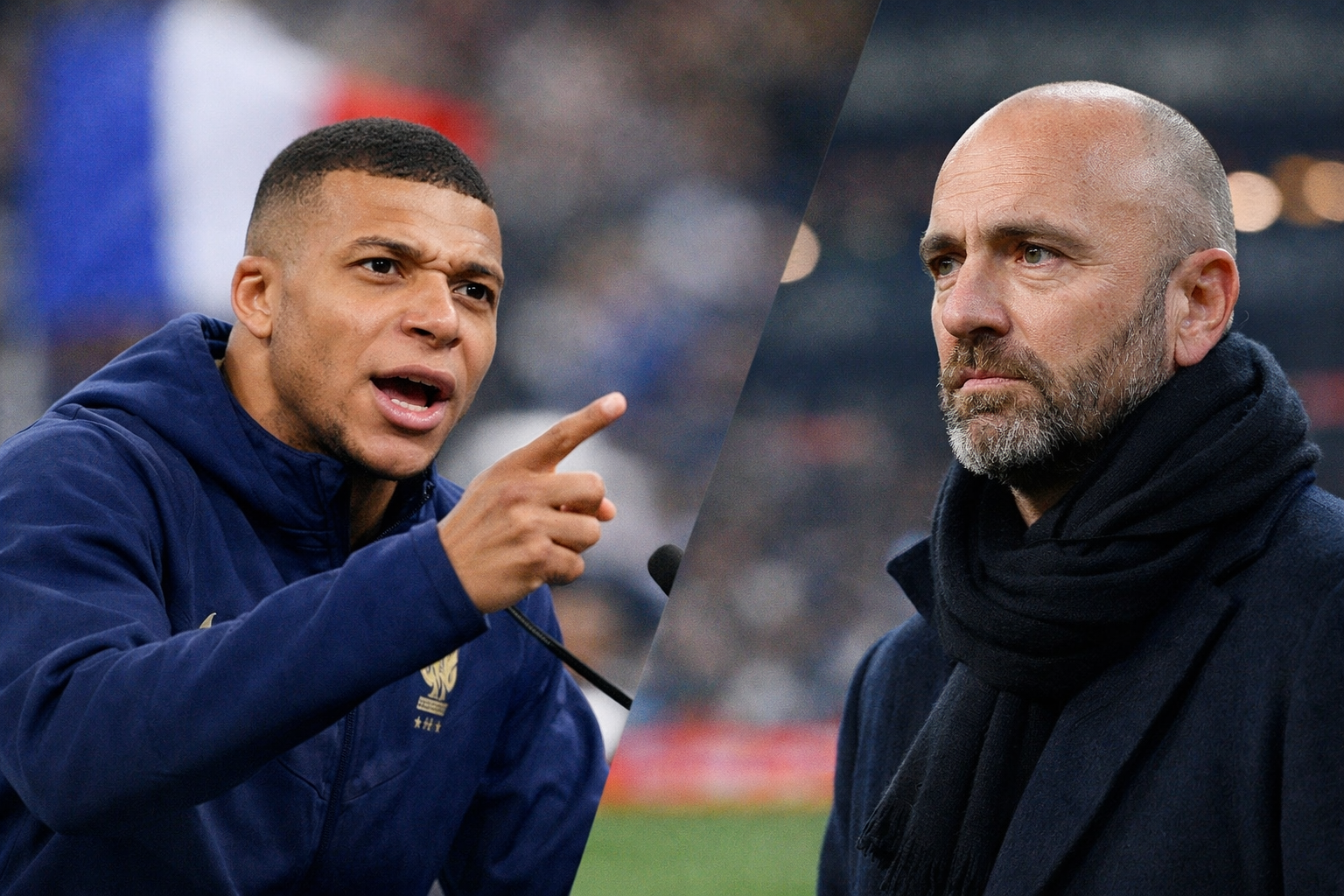
Kylian Mbappe has doubled down on the idea that elite footballers are not insulated from the political reality around them, insisting that public figures still have a duty to speak as citizens when they feel the moment demands it.
In comments given to Vanity Fair, the France captain responded to Jordan Bardella while also making his position on the far right clear. Mbappe argued that money, fame and status do not remove players from the consequences of national politics.
We are not disconnected from the world, nor from what our country is experiencing.
That was the core of Mbappe’s message. His point was not simply that footballers are entitled to opinions, but that their platform does not erase their connection to ordinary life. He suggested the opposite: visibility can increase responsibility.
Mbappe framed the issue in personal as well as civic terms. He said the political direction of France affects him because he understands what is at stake and what the country could become if the wrong people gain power. In that sense, his intervention was not presented as a celebrity opinion dropped into the news cycle for attention. It was a statement rooted in identity, citizenship and concern.
He also pushed back against a common reaction to wealthy athletes entering public debate. The idea that success somehow disqualifies someone from commenting on society remains widespread, particularly when the subject is politically charged. Mbappe’s answer was direct: footballers are citizens first, and that gives them the same right to speak as anyone else.
Mbappe’s stance goes beyond football image management
There is always a temptation to treat moments like this as branding exercises. With a player as globally recognisable as Mbappe, every public statement is often filtered through image, commercial value and media strategy.
But the language here was sharper than standard athlete messaging. Mbappe did not try to stay in the vague middle ground of unity, peace and generic democratic values. He addressed the issue head-on and made it clear that he sees a real political risk in the rise of the far right.
That matters because top-level players rarely speak with this level of clarity on domestic politics, especially during international windows or periods when attention around the national team is at its highest. Silence is usually safer. Ambiguity is easier to manage. Mbappe chose neither.
For France, where football and national identity have long intersected in complicated ways, those words inevitably carry weight. When the national team captain speaks, the reaction extends far beyond sport.
Dugarry does not dispute the right, but the moment
Former France striker and current pundit Christophe Dugarry took issue not with Mbappe’s freedom to speak, but with when and how such interventions land in the national team environment.
Speaking on RMC Sport, Dugarry said Mbappe should not be forbidden from expressing himself. His concern was more practical. In his view, once political comments enter the conversation around the squad, every press conference becomes shaped by them.
That, Dugarry argued, changes the atmosphere.
He warned that journalists would continue to raise the subject, that players would be pulled into responding, and that the cycle of reaction would create avoidable pressure. In an era when footballers live under constant scrutiny online, he also suggested the consequences would not remain limited to broadcast debate.
According to Dugarry, social media hostility would likely intensify, with extreme voices targeting players one after another. His reading of the situation was less about principle and more about squad management: why introduce a source of controversy when the France camp is talented, stable and seemingly united?
In that argument, Dugarry is pointing toward a familiar tension in modern football.
- Players are encouraged to be authentic.
- Captains are expected to lead beyond the pitch.
- National teams want a calm, controlled media environment.
- Political speech almost always disrupts that control.
Dugarry’s line is essentially that even justified opinions can have disruptive consequences inside a high-performance setting.
The pressure on France players is real
On one level, Dugarry’s warning is easy to understand. France players are among the most visible athletes in the world, and political commentary can quickly become a lightning rod.
National team camps are short, compressed and emotionally intense. Every headline can become a distraction. Every answer can trigger a new wave of commentary. In that environment, one player’s intervention can become everybody’s issue.
That is especially true when the player speaking is Mbappe.
He is not just another international. He is the captain, the face of the team and one of the defining figures in global football. His words set the tone. They also raise the expectation that others in the squad will either support, clarify or distance themselves.
For teammates who may prefer silence, that can be uncomfortable. For staff trying to keep focus on football, it can be inconvenient. For supporters already divided politically, it can become combustible.
Dugarry’s concern, then, is not entirely abstract. Public interventions by major players do reshape the media agenda, and in the current digital climate they can expose footballers to abuse at scale.
But silence is also a political choice
Still, the counterargument to Dugarry is a powerful one. Asking players to wait for a better moment often becomes a softer way of asking them not to speak at all.
There is rarely a politically neutral window in elite football. There is always a tournament, a camp, a title race, a transfer story or a dressing-room concern that can be used to argue for postponement. If timing is always the objection, expression can effectively be pushed off the table indefinitely.
That is the space Mbappe seems unwilling to accept.
His comments suggest he believes footballers should not retreat into silence simply because their words may provoke reaction. If an issue matters enough, then the fear of backlash cannot be the deciding factor.
That position carries its own logic.
- High-profile players have influence that most citizens do not.
- Political outcomes affect them and their communities too.
- Public backlash is not proof they should stay silent.
- Leadership can involve speaking when it is uncomfortable.
From that perspective, Dugarry’s appeal for calm may sound less like caution and more like containment.
A wider debate around athlete activism
The exchange also fits into a broader conversation that extends far beyond French football. Across sport, elite athletes are increasingly expected to have social awareness, but often only within limits that remain convenient for audiences, broadcasters and institutions.
Players are praised for values-based leadership until those values become politically specific. Once they do, the response often changes. The same visibility that makes an athlete influential becomes a reason to urge restraint.
Mbappe’s remarks cut directly through that contradiction. He is effectively saying that public stature should not strip someone of the right to take a position on issues affecting their country.
That does not mean every supporter will agree with him. It does mean the old expectation that footballers should stay in their lane is becoming harder to maintain, especially when the players involved see themselves not only as performers but as participants in national life.
What this means for the France camp
Whether Dugarry likes the timing or not, the debate is now part of the conversation around France. That does not automatically mean the squad will be destabilised, but it does guarantee a sharper spotlight.
The immediate questions are straightforward.
- Will other France players choose to back Mbappe publicly?
- Will the coaching staff try to draw a line under the issue?
- Will political debate continue to shadow the team environment?
Much will depend on how the group handles the noise. France has enough experience, seniority and quality to absorb external controversy, but the topic is too significant to be dismissed as a minor side story.
Mbappe has made a deliberate intervention and attached his name to it. Dugarry has responded by warning about the consequences. Between those two positions lies a bigger argument about responsibility, timing and what leadership should look like in modern football.
For now, one point is clear: Mbappe does not believe football fame places him outside the national conversation. He believes it leaves him inside it, with even more reason to speak.